Critically discuss how the interaction of El Niño with localized Western Disturbances influences the spatial distribution and stalling of the southwest monsoon in India.
The southwest monsoon over India is not shaped by one factor alone. El Niño weakens the large-scale monsoon circulation, while Western Disturbances can disrupt its normal northward advance and alter rainfall belts, producing sharp regional contrasts.
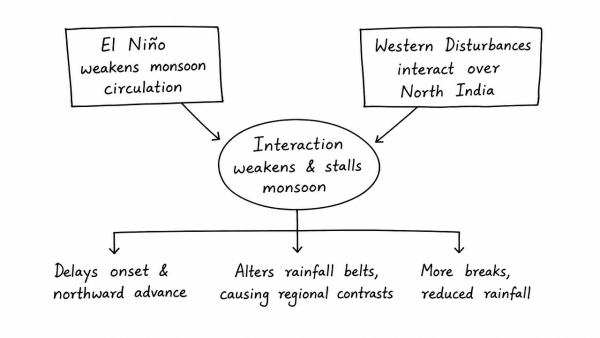
- El Niño and monsoon weakening: El Niño often delays monsoon onset, reduces seasonal rainfall and increases breaks. Around half of El Niño years have seen drought-like rainfall deficits, though the impact varies across regions.
- Uneven spatial response: The link with El Niño is strong in North India and parts of South India, but much weaker in Central India. Coastal Tamil Nadu and Andhra Pradesh often face below-normal rainfall during El Niño, while Odisha shows a less regular response.
- Western Disturbances and stalling: Localised WDs, though mainly winter systems, can extend into the monsoon season. They may hold back the monsoon trough, delay the Northern Limit of Monsoon and create temporary rain bands over north-west India.
- Interaction effect: When El Niño has already weakened moisture flow, a WD can more easily stall monsoon advancement. This leads to prolonged dry spells over central and peninsular India, while north-western regions may receive heavy but short-lived rain.
- Rainfall redistribution: The result is not uniform failure but a broken monsoon pattern: deficits in some states, intense rainfall in others, and greater uncertainty in district-level forecasting.
Thus, the El Niño-WD interaction does not merely reduce rainfall; it redistributes it in space and time. For India, the key challenge is to anticipate these coupled disruptions through better regional forecasting and preparedness.
Originally written on
September 13, 2026
and last modified on
September 13, 2026.