Critically discuss how the Indo-Russian collaboration in civilian nuclear energy, exemplified by Kudankulam, serves as a cornerstone for India’s strategic autonomy amidst shifting global alliances.
Indo-Russian civilian nuclear cooperation, especially at Kudankulam, is more than an energy project. It reflects India’s ability to secure critical technology, diversify partners, and preserve policy freedom in a fractured global order. The partnership has endured sanctions, geopolitical shocks and alliance shifts because it is driven by long-term national interest.
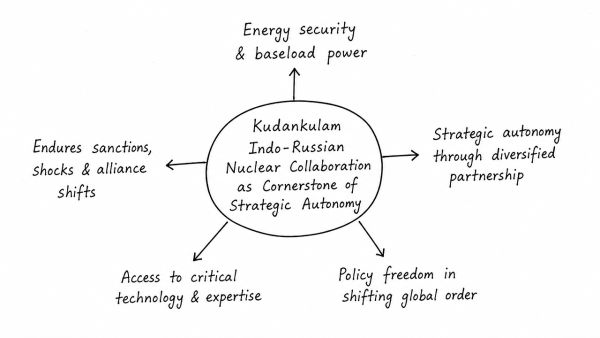
- Energy security and baseload power
Kudankulam provides reliable, low-carbon electricity at scale. Units 1 and 2 are operational, while the remaining units are moving ahead, helping India reduce dependence on fossil fuels and stabilise its power mix. - Strategic autonomy through diversification
Russia remains a trusted supplier of reactors, fuel and technical support. This reduces India’s exposure to any single bloc and gives it room to engage the US, Europe, Japan and others on its own terms. - Technology and capability building
The collaboration supports localisation, engineering learning and future cooperation in SMRs, floating reactors, nuclear medicine and digital plant management. This strengthens India’s industrial and technological sovereignty. - Geopolitical hedge in a changing world
As Russia faces Western pressure and leans more towards China, India’s continued engagement shows calibrated diplomacy. It keeps a strategic channel open with Moscow without compromising ties elsewhere. - Limits and risks
Delays, cost escalation, sanctions-related supply issues and dependence on Russian design expose vulnerabilities. India must avoid over-reliance and accelerate domestic research, fuel cycle capacity and private sector participation.
Thus, Kudankulam symbolises India’s pragmatic multi-alignment: partnership without dependence, cooperation without alliance lock-in, and energy security without strategic compromise. Its true value lies not only in megawatts, but in preserving India’s room to manoeuvre in an uncertain world.
Originally written on
September 13, 2026
and last modified on
September 13, 2026.