Critically discuss how infrastructural bottlenecks in the North Eastern Region hinder agricultural export competitiveness under APEDA. What steps are needed?
North Eastern Region has high export potential in organic produce, spices, fruits and GI-tagged crops, but weak infrastructure keeps it far below its potential under APEDA. Poor logistics, weak cold chains and limited testing facilities raise costs, delay shipments and reduce product quality.
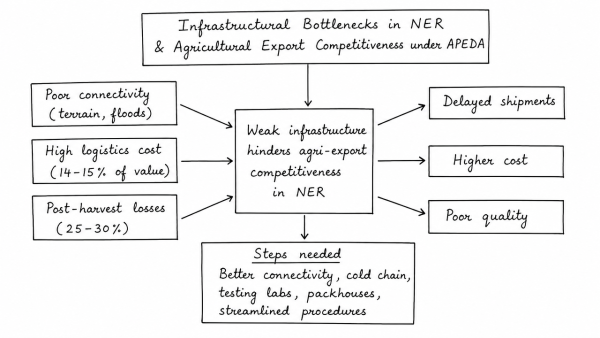
- Connectivity bottlenecks: Hilly terrain, floods and landslides disrupt roads, rail and air links. Logistics costs remain around 14-15% of export value, far above global benchmarks.
- Post-harvest losses: Lack of packhouses, cold storage, ripening and irradiation facilities causes 25-30% losses in perishables such as pineapple, litchi and vegetables.
- Quality compliance gaps: Few accredited labs in the region force exporters to send samples outside, increasing delay and cost. This weakens traceability and residue control.
- Market access constraints: Small producers, weak aggregation and few processing units reduce scale, value addition and bargaining power.
| Impact | Result |
| Slow transport | Lower shelf life and export rejection risk |
| Poor storage | Higher wastage and distress sales |
| Testing gaps | Compliance failure in premium markets |
- Build multimodal links: Faster roads, railways, inland waterways and airport cargo facilities, linked to border trade routes and logistics parks.
- Strengthen cold chain: Packhouses, reefer transport, perishables centres and processing clusters in production belts.
- Expand labs and certification: Accredited residue-testing, organic certification and traceability systems within the region.
- Support farmers and FPOs: Training, aggregation, contract farming and export awareness through APEDA.
- De-risk investment: Better credit, simpler clearances and climate-resilient infrastructure for floods and landslides.
In short, APEDA can raise NER’s export competitiveness only when physical connectivity, post-harvest systems and compliance infrastructure grow together. The region should shift from a raw produce base to a reliable, quality-driven export hub.
Originally written on
September 12, 2026
and last modified on
September 12, 2026.