Critically Analyse why offshore wind development impacts coastal fishing communities’ livelihoods. How can a “just transition” framework protect vulnerable groups while expanding renewable infrastructure?
Offshore wind is vital for clean energy, but it also reorders coastal space, ecology and local economies. For fishing communities, the main issue is not opposition to renewables, but loss of access, higher costs and weak protection against disruption.
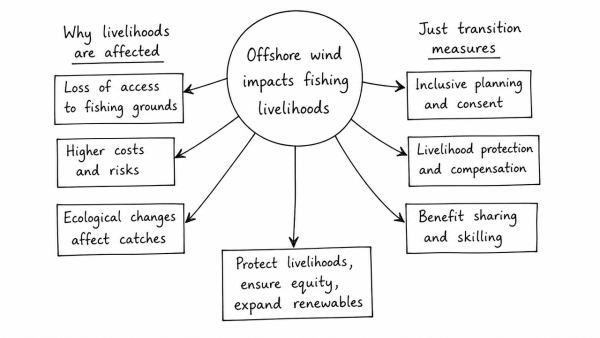
- Why livelihoods are affected
- Wind farms occupy traditional fishing grounds, especially for mobile gear users, forcing longer journeys and higher fuel costs.
- Construction, cables and turbine structures can damage gear, raise safety risks and complicate navigation.
- Noise, sediment movement and habitat change may alter fish distribution, even if some structures later act like artificial reefs.
- Income falls when catch is reduced, while support services such as harbour trade, processing and transport also suffer.
- These effects hit small-scale fishers hardest, as they have low savings, weak bargaining power and limited alternative work.
- Critical concerns
- Benefits of clean power are national, but costs are local and concentrated.
- Decision-making is often top-down, with poor data on cumulative socio-economic loss.
- Without spatial planning, offshore wind can deepen existing inequalities in coastal regions.
- How just transition can help
- Start early consultation with fishers in marine spatial planning and project design.
- Provide fair compensation for income loss, gear damage and temporary closures.
- Protect customary fishing access where compatible with safety and operations.
- Offer retraining, local jobs, harbour upgrades and support for allied livelihoods.
- Ensure community benefit sharing, transparent monitoring and grievance redress.
A just transition does not stop offshore wind; it makes expansion socially legitimate. The goal should be clean energy growth without pushing vulnerable fishing households into deeper poverty.
Originally written on
September 13, 2026
and last modified on
September 13, 2026.