Critically analyse how uncontrolled urban geometry and the Urban Heat Island effect accelerate localized climate tipping points. What passive cooling measures can reverse this trend?
Uncontrolled urban geometry turns cities into heat traps. Dense high-rise blocks, narrow streets, hard paving and the loss of trees or water bodies raise temperatures, especially at night, and push urban systems closer to local climate tipping points.
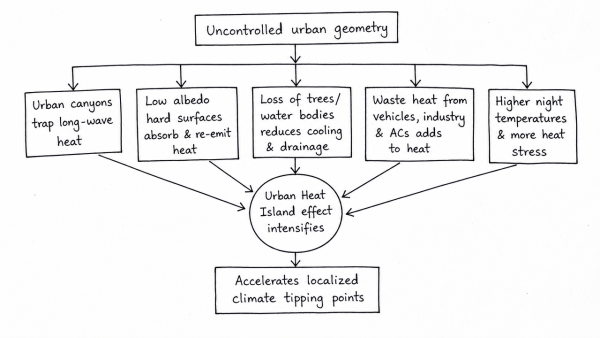
- How urban form accelerates tipping points
- Urban canyons block wind flow and trap long-wave heat.
- Concrete and asphalt have low albedo, absorb solar radiation and re-emit it slowly.
- Replacing wetlands, lakes and soils with built surfaces weakens drainage, evaporation and flood buffering.
- Waste heat from vehicles, industry and air conditioners adds to the thermal load.
- Why this becomes a tipping-point risk
- Heatwaves become longer, more frequent and more intense, stressing water, health and power systems.
- Flash floods worsen as sealed surfaces and altered storm patterns overwhelm drainage.
- Vulnerable groups face higher illness, mortality and productivity loss, deepening thermal inequality.
- Once trees, wetlands or urban ecosystems cross critical stress limits, recovery becomes slow and costly.
- Passive cooling measures
- Green infrastructure: street trees, parks, urban forests, green roofs and green walls.
- Blue infrastructure: protect and restore ponds, lakes, streams and wetlands.
- Cool materials: high-albedo roofs, reflective pavements and permeable surfaces.
- Better urban design: wider street corridors, shading, ventilation paths and lower plot coverage.
- Building design: insulation, cross-ventilation, shaded openings, thermal mass and solar-control films.
Thus, passive cooling is not a luxury but a resilience strategy. Cities must shift from heat-producing sprawl to climate-sensitive form, so that urban growth does not cross irreversible local heat and flood thresholds.
Originally written on
September 13, 2026
and last modified on
September 13, 2026.