‘Constitutional Morality’ is rooted in the Constitution itself and is founded on its essential facets. Explain the doctrine of ‘Constitutional Morality’ with the help of relevant judicial decisions. (UPSC 2021)
Constitutional morality means fidelity to the Constitution’s values—liberty, equality, dignity, justice and rule of law—rather than to social or majoritarian morality.
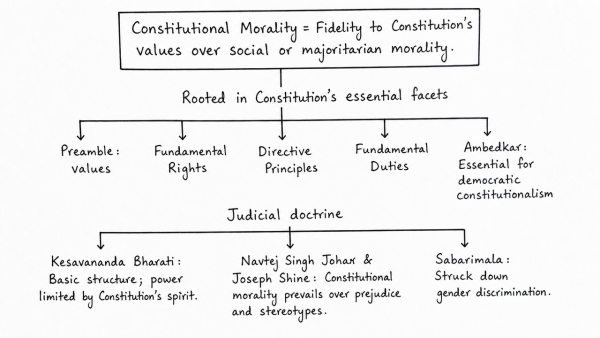
- Foundations: Its moral core flows from the Preamble, Fundamental Rights, Directive Principles and Fundamental Duties; Ambedkar saw it as essential for sustaining democratic constitutionalism.
- Judicial doctrine: In Kesavananda Bharati, the Court protected the basic structure and limited constitutional power by its spirit. In Navtej Singh Johar and Joseph Shine, it held that constitutional morality prevails over prejudice and stereotypes. In Sabarimala, it was used to strike down gender discrimination; in Manoj Narula, to insist on probity in public life. Government of NCT of Delhi stressed cooperation and restraint among constitutional authorities.
Thus, constitutional morality is the ethical discipline that keeps power within constitutional limits and secures rights against arbitrariness, tradition and majoritarian excess.
Originally written on
September 2, 2026
and last modified on
September 2, 2026.