Constitutional mechanisms to resolve the inter-state water disputes have failed to address and solve the problems. Is the failure due to structural or process inadequacy or both? Discuss. (UPSC 2013)
Inter-state water disputes in India are not failing because of one flaw alone. The constitutional scheme has both structural weaknesses in design and process inadequacies in operation, which together make resolution slow, adversarial and often ineffective.
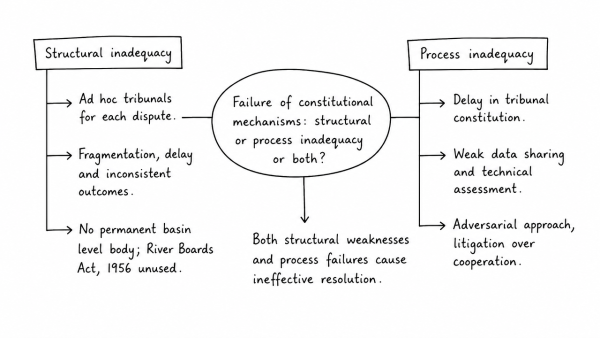
- Structural inadequacy: Article 262 permits Parliament to exclude court jurisdiction, but the system relies on ad hoc tribunals for each dispute. This creates fragmentation, delay and inconsistent outcomes.
- Weak institutional support: The River Boards Act, 1956 has remained unused, so there is no permanent basin-level planning body. Water data and technical assessment also remain disputed between States.
- Process inadequacy: Even where tribunals are formed, they suffer from repeated extensions, poor coordination and limited enforcement power. Awards are often challenged through other constitutional routes, reducing finality.
- Political factor: Water is treated as an electoral issue, making compromise difficult and compliance weaker.
Thus, the failure is due to both structure and process. A permanent, expert-driven and cooperative basin management mechanism, backed by timely adjudication and enforcement, is needed for durable settlement.
Originally written on
August 28, 2026
and last modified on
September 7, 2026.