Considering the threats cyberspace poses for the country, India needs a “Digital Armed Force” to prevent crimes. Critically evaluate the National Cyber Security Policy, 2013 outlining the challenges perceived in its effective implementation. (UPSC 2015)
Cyberspace is now a domain of conflict, and India faces rising attacks on citizens, firms and critical infrastructure. A “digital armed force” is therefore justified, but it must work with civil institutions, not replace them.
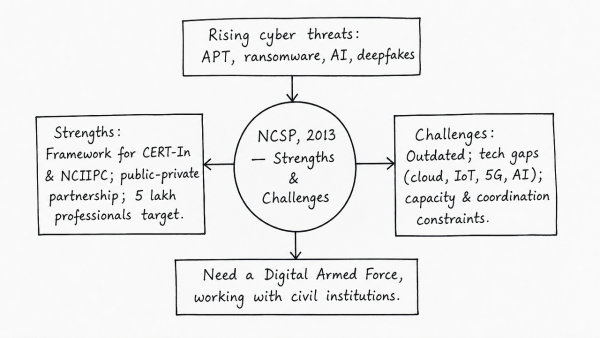
- Need: India saw cyber incidents rise sharply, while threats now include APTs, ransomware, AI-based phishing and deepfakes.
- NCSP 2013 strengths: It created a framework for CERT-In and NCIIPC, stressed public-private partnership, and set an ambitious target of training 5 lakh cyber professionals.
- Limits: The policy is outdated, as it predates cloud, IoT, 5G and AI-led threats.
- Implementation gaps: Cyber governance is fragmented among MeitY, MHA, NSCS and sectoral bodies, causing weak coordination.
- Other challenges: shortage of skilled staff, poor compliance culture, lack of statutory force, and dependence on foreign hardware and software.
Thus, NCSP 2013 was a useful start, but it is no longer adequate. India needs a stronger, legally backed cyber doctrine, unified command, skilled manpower and secure supply chains to build real digital deterrence.
Originally written on
August 30, 2026
and last modified on
August 30, 2026.