‘Communalism arises either due to power struggle or relative deprivation.’ Argue by giving suitable illustrations. (UPSC 2018)
Communalism in India is not merely religious sentiment; it often grows from power struggle or relative deprivation, and the two usually reinforce each other.
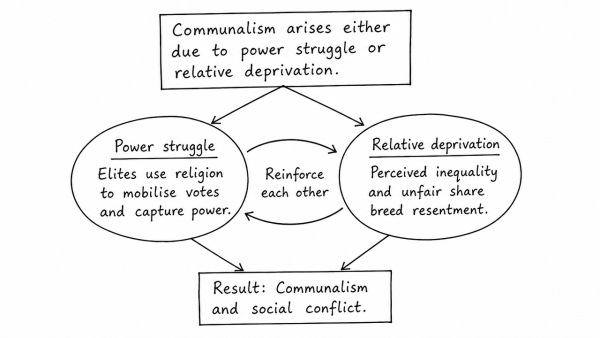
Power struggle
- Religion is used to mobilise votes, build group loyalty and capture power; T.K. Oommen and Bipan Chandra note that elites can convert identity into political support.
- The Partition of 1947 is a classic case: competing political elites mobilised religious identities while bargaining for authority.
- Even today, election-time polarisation, hate speech and vote-bank politics show communalism as a strategy of political competition.
Relative deprivation
- Communal tension also arises when a community feels denied fair access to jobs, education, public goods or political voice, even if the deprivation is partly perceived.
- Ted Robert Gurr’s idea of frustration helps explain why unmet expectations can turn into resentment and mobilisation.
- The Sachar Committee highlighted Muslim under-representation in education, public employment and formal sector jobs, which has fed a sense of exclusion.
- At times, majority groups also feel “deprived” by minority welfare or protective measures, which can fuel counter-communal reactions.
Thus, communalism is driven both by elite competition for power and by real or perceived deprivation at the social level; it can be curbed only through equitable development, inclusive politics and firm action against hate mobilisation.
Originally written on
August 31, 2026
and last modified on
August 31, 2026.