Comment on the National Wetland Conservation Programme initiated by the Government of India and name a few India’s wetlands of international importance included in the Ramsar Sites. (UPSC 2023)
The National Wetland Conservation Programme was launched in 1985-86 to curb the degradation of wetlands and ensure their wise use. It aimed to protect biodiversity, regulate water regimes, and support local livelihoods through sustainable management.
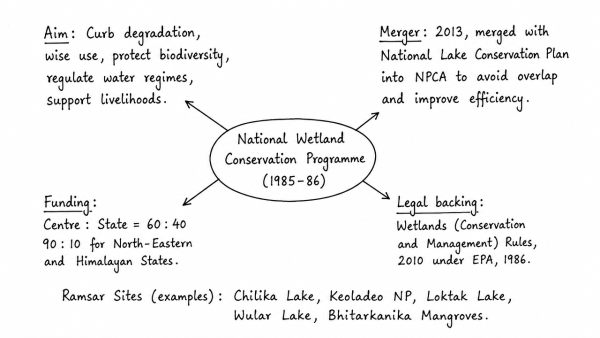
- Merger and institutional change: In 2013, NWCP was merged with the National Lake Conservation Plan into the National Plan for Conservation of Aquatic Eco-systems (NPCA) to avoid overlap and improve efficiency.
- Funding pattern: Under NPCA, funding is shared between Centre and States in a 60:40 ratio, and 90:10 for North-Eastern and Himalayan States.
- Legal backing: The Wetlands (Conservation and Management) Rules, 2017 strengthen protection by banning reclamation, untreated waste disposal and unplanned commercial construction.
- Decentralised governance: State Wetland Authorities have been set up to identify, monitor and manage wetlands at the State level.
- Current push: Schemes like Amrit Dharohar seek to involve communities, promote nature-based tourism and build local stewardship.
However, gaps remain. India has lost a large share of its wetlands to urban growth, encroachment, pollution and weak coordination among departments. Many wetlands are privately owned, making enforcement difficult. Thus, conservation must move beyond notification to real protection and restoration.
- Some Ramsar sites of international importance in India: Chilika Lake, Keoladeo National Park, Loktak Lake, Wular Lake, Vembanad-Kol Wetland, and Sundarban Wetland.
- Other important sites: Sambhar Lake, Bhoj Wetlands, Kolleru Lake, and Harike Wetland.
Overall, NWCP laid the foundation for wetland conservation, but its success depends on stronger enforcement, community participation, and integration of wetlands into development planning.
Originally written on
September 4, 2026
and last modified on
September 4, 2026.