‘Climate change’ is a global problem. How will India be affected by climate change? How will Himalayan and coastal states of India be affected by climate change? (UPSC 2017)
Climate change is a major development, health and security challenge for India. It is already causing hotter extremes, erratic monsoons, floods, droughts and rising pressure on farms, cities and infrastructure.
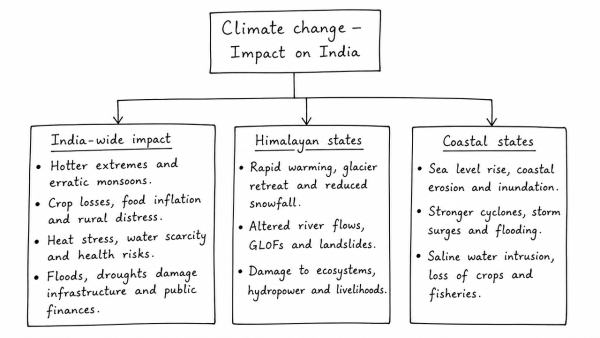
- India-wide impact: Crop losses, food inflation and rural distress will rise as rainfall becomes more uncertain. Heat stress will reduce labour productivity, increase heatstroke and worsen water scarcity. Floods and droughts will damage housing, roads, sanitation and public finances, slowing growth and increasing disaster spending.
| Himalayan states | Coastal states |
| Rapid warming, glacier retreat and reduced snowfall will alter river flows and drinking water supply. These states will face glacial lake outburst floods, landslides, cloudbursts and winter droughts. Fragile slopes and seismicity amplify risk to settlements and hydropower. | Sea-level rise, coastal erosion, saline intrusion and stronger cyclones will damage farms, aquifers, ports and settlements. Low-lying deltas and islands face higher flooding, displacement and losses to fisheries, tourism and salt-sensitive agriculture. |
Therefore, climate change will deepen regional vulnerabilities in India, demanding mitigation, adaptation, early warning systems, ecosystem protection and climate-resilient planning with special focus on the Himalayas and coasts.
Originally written on
August 31, 2026
and last modified on
August 31, 2026.