Clarify how mid-eighteenth century India was beset with the spectre of a fragmented polity. (UPSC 2017)
By the mid-eighteenth century, India no longer had a strong imperial centre. Mughal authority had shrunk to a nominal symbol, while power passed to regional chiefs, warriors and governors. The result was a patchwork of competing states rather than a united polity.
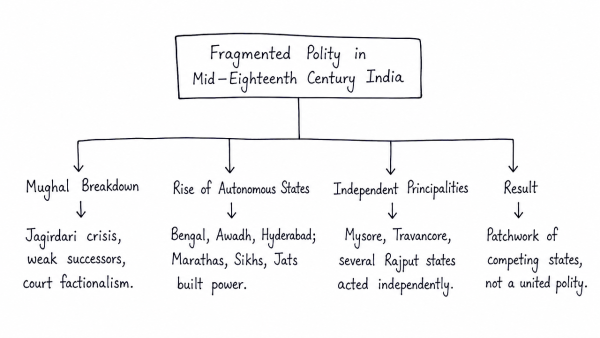
- Mughal breakdown: The jagirdari crisis, weak successors and court factionalism ruined central control and revenue flow.
- Rise of autonomous states: Bengal, Awadh and Hyderabad became successor states, while Marathas, Sikhs and Jats built power through armed resistance.
- Independent principalities: Mysore, Travancore and several Rajput states acted on their own interests.
- Constant conflict: Rivalry over land, tribute and trade produced wars, predatory taxation and shifting alliances.
- Foreign intrusion: Nadir Shah and Ahmad Shah Abdali exposed Mughal weakness; European companies exploited the vacuum.
Thus, mid-eighteenth century India was marked by political fragmentation, fiscal decentralisation and military instability, creating conditions for the eventual rise of British power.
Originally written on
August 31, 2026
and last modified on
August 31, 2026.