China and Pakistan have entered into an agreement for development of an economic corridor. What threat does this pose for India’s security? Critically examine. (UPSC 2014)
China-Pakistan Economic Corridor (CPEC) is not merely an economic project; it has clear security implications for India. By passing through Pakistan-occupied Kashmir and Gilgit-Baltistan, it challenges India’s sovereignty and legitimises Pakistan’s hold over disputed territory.
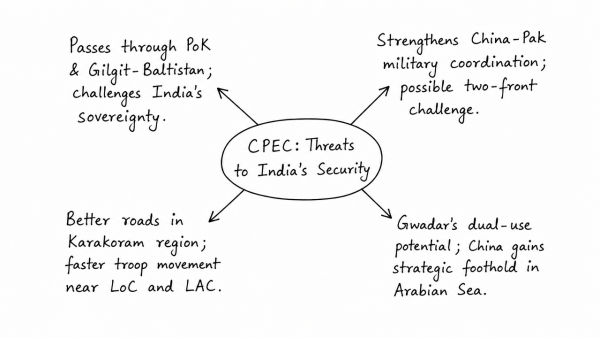
- Strategic threat: It strengthens China-Pakistan military coordination, creating pressure of a possible two-front challenge for India.
- Border impact: Better roads and connectivity in the Karakoram region can improve rapid troop movement near the Line of Control and the Line of Actual Control.
- Maritime danger: Gwadar may serve dual-use military purposes, helping China gain a foothold close to the Strait of Hormuz and the Arabian Sea.
- Cyber and intelligence risk: Digital links under CPEC can support surveillance, cyber espionage and intelligence sharing against India.
However, CPEC also faces local insecurity in Pakistan and economic constraints. Still, its strategic value for China makes it a major challenge for India’s territorial integrity, military preparedness and regional influence.
Originally written on
August 29, 2026
and last modified on
August 29, 2026.