Bring out the constructive programmes of Mahatma Gandhi during Non-Cooperation Movement and Civil Disobedience Movement. (UPSC 2021)
Mahatma Gandhi’s constructive programmes were the positive, nation-building side of his struggle for swaraj. They aimed to prepare society for self-rule through self-reliance, social reform and mass participation, alongside direct political action.
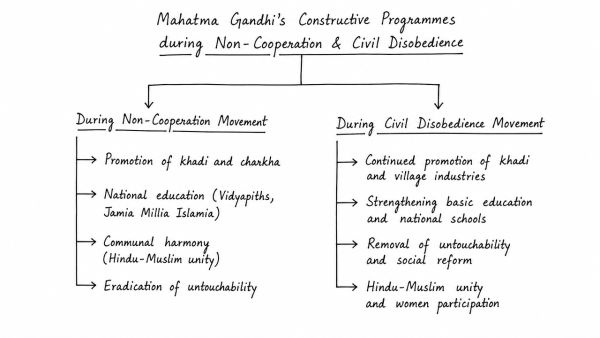
- During the Non-Cooperation Movement
- Promotion of khadi and charkha to revive indigenous industry, create self-reliance and challenge imported cloth.
- National education through Kashi Vidyapith, Gujarat Vidyapith, Bihar Vidyapith and Jamia Millia Islamia, to replace colonial education with value-based learning.
- Communal harmony by linking Non-Cooperation with Khilafat and stressing Hindu-Muslim unity.
- Eradication of untouchability as part of the political struggle, not as a separate social issue.
- Anti-liquor and anti-opium picketing to promote moral discipline and reduce colonial revenue.
- People’s justice through local arbitration and nyaya panchayats, reducing dependence on colonial courts.
- During the Civil Disobedience Movement
- Harijan uplift gained greater focus after 1932, with the Harijan Sevak Sangh working for temple entry, education and access to wells.
- Women’s participation expanded through picketing, salt satyagraha and boycott campaigns, making the movement socially wider.
- Village industries were strengthened through the All India Village Industries Association to revive rural crafts and employment.
- Sanitation and hygiene were stressed in ashrams as practical training for civic reform.
- Nai Talim promoted craft-centred, mother-tongue education linking mind, hand and heart.
Thus, Gandhi’s constructive programmes were not mere add-ons. They built social discipline, economic independence and national unity, making mass movements more enduring and giving swaraj a moral and practical base.
Originally written on
September 2, 2026
and last modified on
September 2, 2026.