Briefly mention the alignment of major mountain ranges of the world and explain their impact on local weather conditions, with examples. (UPSC 2021)
Mountain ranges are aligned mainly in two broad ways: east-west and north-south. Their orientation strongly affects the movement of winds, rain-bearing clouds, and air masses, so they shape local weather and climate.
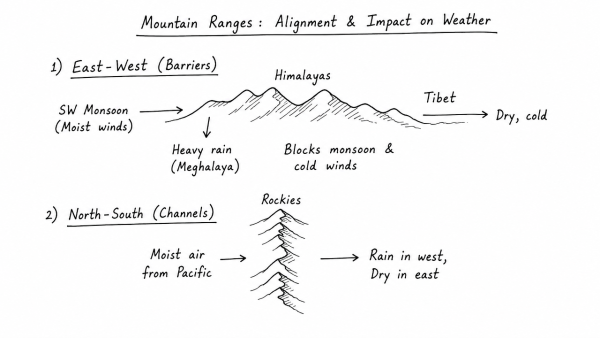
- East-west aligned ranges act as strong climatic barriers.
- The Himalayas block the southwest monsoon, causing heavy rainfall on the southern slopes and foothills, as seen in Meghalaya, while the Tibetan Plateau remains dry and cold.
- They also stop cold, dry Central Asian winds from entering India, helping keep the subcontinent relatively warmer in winter.
- The Alps similarly restrict cold northern air and create mild Mediterranean conditions on the southern side.
- North-south aligned ranges allow air masses to move more freely across latitudes.
- The Andes form a long barrier along South America’s west coast. Moist easterly winds give heavy rain on the eastern slopes, while the west has arid conditions, including the Atacama Desert.
- The Rockies produce Chinook winds on the leeward side, bringing sudden warming and snowmelt.
- The Western Ghats force moisture-laden monsoon winds to rise, giving very heavy rain on the Malabar coast, while the Deccan Plateau lies in a rain-shadow zone.
Thus, the alignment of mountain ranges determines whether they block winds, cause orographic rainfall, create rain shadows, or allow warm and cold air to travel freely.
In short, mountain orientation is a key control on local weather. It explains sharp contrasts in rainfall, temperature, and wind patterns over short distances.
Originally written on
September 2, 2026
and last modified on
September 2, 2026.