Border management is a complex task due to difficult terrain and hostile relations with some countries. Elucidate the challenges and strategies for effective border management. (UPSC 2016)
Border management in India is difficult because borders are long, varied and often disputed. Hostile relations, smuggling networks and new technologies such as drones make surveillance and response more demanding.
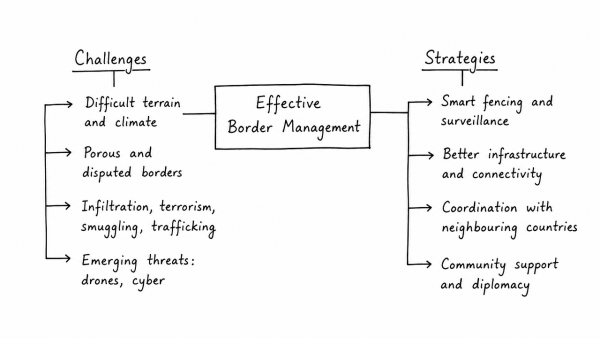
- Major challenges: High mountains, snow and extreme cold on the LAC and in Ladakh hinder patrolling. Riverine, swampy and shifting borders such as Sir Creek and Brahmaputra channels cannot be fenced easily. Dense forests along the Indo-Myanmar border aid insurgents.
- Security threats: Infiltration, cross-border terrorism, arms and drug trafficking, fake currency and human trafficking remain serious concerns. Drone drops along the western border have added a low-cost, hard-to-detect threat.
- Institutional issues: Multiple agencies, weak coordination, poor roads, and gaps in technology and local intelligence reduce operational effectiveness.
- Strategies: Use a force-specific approach with clear jurisdiction and better inter-agency coordination.
- Build all-weather roads, tunnels, border outposts, floodlights and secure connectivity.
- Adopt smart fencing, sensors, thermal cameras, radars, anti-drone systems and integrated surveillance under CIBMS and other modern grids.
- Strengthen coastal and riverine security, especially in porous stretches.
- Develop border villages through the Vibrant Villages Programme so local people become stakeholders in security.
Effective border management needs a mix of hard power, technology and development. A secure border is best achieved not only by fencing and patrols, but also by reliable infrastructure, local participation and sustained diplomacy with neighbours.
Originally written on
August 31, 2026
and last modified on
August 31, 2026.