Besides the welfare schemes, India needs deft management of inflation and unemployment to serve the poor and the underprivileged sections of the society. Discuss. (UPSC 2022)
Welfare schemes are essential for immediate relief, but they cannot by themselves end poverty. For the poor and underprivileged, stable prices and secure livelihoods matter as much as transfers, because inflation reduces real incomes and unemployment limits dignity and mobility.
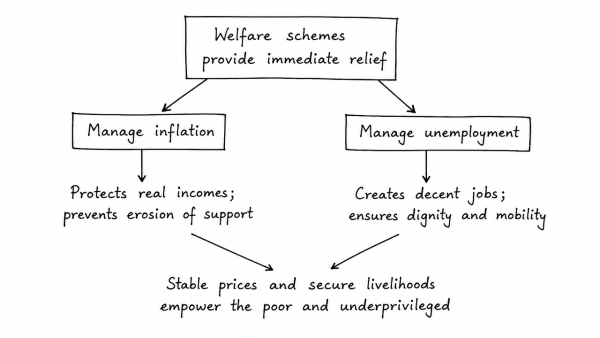
- Why inflation matters: High food and fuel inflation acts like a regressive tax. Poor households spend a large share of income on essentials, so even moderate price rise quickly weakens the value of DBT, pensions and food support.
- Why unemployment matters: India’s challenge is not only joblessness, but low-quality and informal work. Youth and educated unemployment remain high, while most workers lack formal training, social security and wage protection.
- Constitutional duty: DPSP under Articles 38, 39, 41 and 43 require the State to secure livelihood, reduce inequality and ensure a decent standard of life. This needs more than welfare; it needs economic empowerment.
- Policy priorities:
- Use monetary and supply-side measures to contain food, fuel and input inflation.
- Strengthen storage, logistics and market linkages to reduce price shocks.
- Create labour-intensive growth through manufacturing, construction, care services and MSMEs.
- Expand skilling, apprenticeships and formalisation for youth and informal workers.
- Link welfare with work opportunities through schemes such as employment incentives and public works.
Thus, welfare is necessary for protection, but not sufficient for justice. The poor need a combined strategy of price stability, employment generation and targeted welfare so that temporary relief becomes lasting empowerment.
Originally written on
September 3, 2026
and last modified on
September 3, 2026.