Assess the role of National Horticulture Mission (NHM) in boosting the production, productivity and income of horticulture farms. How far has it succeeded in increasing the income of farmers? (UPSC 2018)
National Horticulture Mission (NHM), later integrated into MIDH, has supported India’s shift to high-value crops by funding quality planting material, irrigation, protected cultivation, rejuvenation of orchards, post-harvest infrastructure and market linkages.
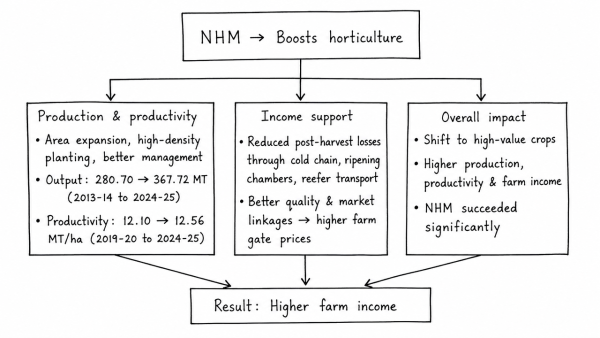
- Production and productivity: It expanded area under horticulture, promoted high-density planting, improved nurseries and orchard management, and helped raise horticulture output from 280.70 million tonnes in 2013-14 to 367.72 million tonnes in 2024-25. Average productivity also improved from 12.10 MT/ha in 2019-20 to 12.56 MT/ha in 2024-25.
- Income support: By reducing post-harvest losses through cold stores, ripening chambers, reefer vans and primary processing units, NHM improved price realisation. Adoption of micro-irrigation and protected cultivation increased returns, and some studies report beneficiary income gains of around 25%.
- Limits: Benefits have been uneven across regions and crops. Small and marginal farmers often face weak cold chains, limited quality planting material, high input costs, price volatility and fragmented implementation, so gains are not universal.
Thus, NHM has significantly boosted horticulture production and productivity and has raised incomes where technology, infrastructure and markets converged, but its overall impact on farmer incomes remains partial and uneven.
Originally written on
September 1, 2026
and last modified on
September 1, 2026.