Assess the role of British imperial power in complicating the process of transfer of power during the 1940s. (UPSC 2019)
The transfer of power in the 1940s was not a smooth constitutional handover but a hurried and conflicted process. British imperial policy, shaped by wartime pressures, weak political will and divide-and-rule instincts, made the transition far more disorderly than necessary.
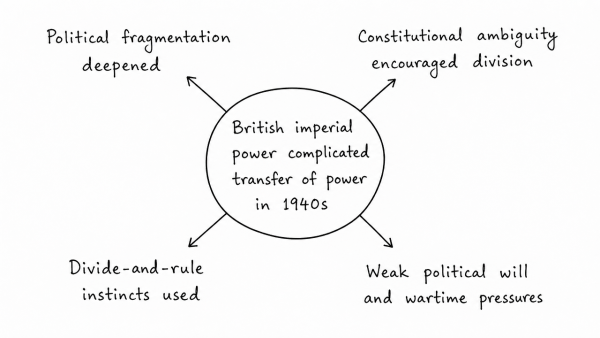
- Political fragmentation was deepened: After Quit India, Congress leaders were jailed and the party was banned, creating a political vacuum. The British then relied increasingly on the Muslim League as a counterweight, which sharpened communal bargaining and distrust.
- Constitutional ambiguity encouraged division: The August Offer and Cripps Mission accepted Dominion Status while allowing provinces to stay out. This introduced the logic of secession early and made partition appear a legitimate option.
- The Cabinet Mission failed to settle key issues: Its grouping scheme for provinces was left vague, especially on whether groups were compulsory or optional. British unwillingness to clarify this helped the plan collapse and widened communal polarisation.
- Princely states were left in uncertainty: By ending paramountcy without a clear transfer of authority over about 565 states, the British created a legal vacuum. This made integration difficult and later contributed to crises in Kashmir, Hyderabad and Junagadh.
- The timetable was dangerously rushed: Mountbatten advanced the date of transfer by several months. Radcliffe was given only weeks to draw borders, with limited data and no field survey, which increased administrative confusion and violence.
Thus, British imperial power complicated transfer of power through delay, ambiguity, selective support to communal forces and a hasty exit. The result was not merely independence, but an unstable and violent partition of authority, territory and people.
Originally written on
September 1, 2026
and last modified on
September 1, 2026.