Assess the importance of the accounts of the Chinese and Arab travellers in the reconstruction of the history of India. (UPSC 2018)
Chinese and Arab travellers are vital for reconstructing India’s past, especially where indigenous sources are scarce or fragmentary. They provide external, often contemporary, observations on politics, society, religion and economy.
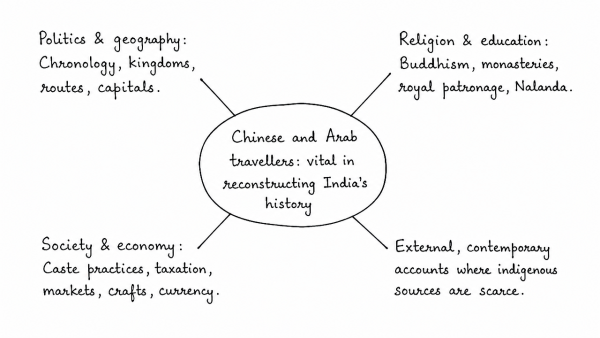
- Political and geographic data: Faxian, Xuanzang and Yijing help identify Gupta and Harsha-era chronology, kingdoms, routes and capitals.
- Religion and education: Their accounts of Buddhism, monasteries, royal patronage and Nalanda reveal the scale and organisation of learning.
- Society and economy: Faxian noted caste practices and currency use; Ibn Battuta and Al-Biruni described taxation, markets, crafts, caste rigidity and Indian Ocean trade.
- Value and limits: Al-Biruni’s Kitab-ul-Hind is especially important for Indian science and customs, but these accounts are selective and need corroboration from inscriptions, coins and archaeology.
Thus, these travellers are indispensable for filling gaps, cross-checking native sources and enriching India’s historical reconstruction.
Originally written on
August 31, 2026
and last modified on
August 31, 2026.