Are we losing our local identity for the global identity? Discuss. (UPSC 2019)
Globalisation has certainly created pressures that can dilute local cultures, but it has not simply erased them. In many cases, local identities are being reshaped, marketed and even strengthened through global platforms. The real issue is not loss alone, but the balance between homogenisation and glocalisation.
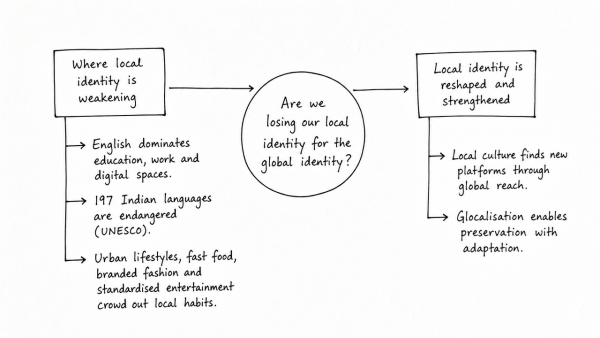
- Where local identity is weakening:
- English dominates education, work and digital spaces, reducing the use of mother tongues.
- UNESCO lists 197 Indian languages as endangered, showing real linguistic stress.
- Urban lifestyles, fast food, branded fashion and standardised entertainment often crowd out regional habits, dress and cuisine.
- Where local identity is surviving and adapting:
- Article 29 protects the right to conserve language, script and culture, while Article 350A supports mother-tongue education.
- GI tags, ODOP and Vocal for Local have turned crafts, foods and textiles into stronger local brands.
- Indian languages are gaining digital space, with rising regional content, voice search and AI tools such as Bhashini helping preservation.
- Global firms also localise products, proving that markets reward cultural diversity.
- Analytical view:
- Global identity need not mean cultural sameness.
- When local traditions are re-packaged for wider markets, they gain visibility, income and continuity.
Thus, we are not fully losing local identity, but it is under strain in some areas, especially language and everyday practices. The challenge is to ensure that global participation does not come at the cost of cultural roots. A confident nation can be globally connected while remaining deeply local.
Originally written on
September 1, 2026
and last modified on
September 1, 2026.