Are tolerance, assimilation and pluralism the key elements in the making of an Indian form of secularism? Justify your answer. (UPSC 2022)
Indian secularism is not based on a strict wall between religion and state. It is built on equal respect, peaceful coexistence and constitutional protection of diversity, while allowing the State to intervene for reform and equality.
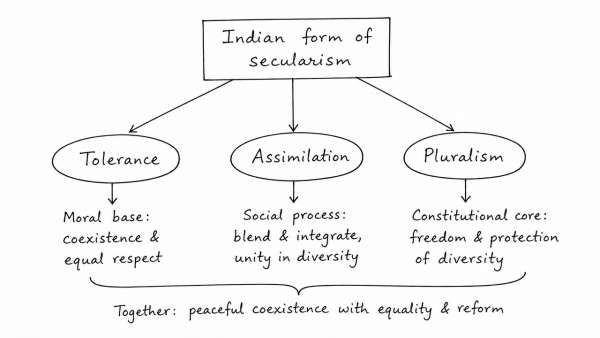
- Tolerance: This is the moral base. Indian tradition values coexistence, from Ashoka to Sufi-Bhakti traditions and sarva dharma sambhava. The Constitution also encourages this through Article 51A(f), which asks citizens to value the composite heritage of India.
- Pluralism: This is the constitutional core. Articles 25 to 28 protect freedom of religion, while Articles 29 and 30 safeguard the language, culture and educational rights of minorities. India accepts diversity as a permanent feature, not a problem to be removed.
- Assimilation: In India, this does not mean forced cultural uniformity. It means voluntary social and cultural synthesis, such as shared festivals, mixed traditions and a common civic identity. The Constitution rejects coercive assimilation through protections for minorities and tribal communities.
Why these three matter together: tolerance enables coexistence, pluralism gives legal protection, and assimilation creates national integration without erasing identities.
- Limits: These are important, but not the only elements. Indian secularism also rests on constitutional morality, fundamental rights, equality, and the State’s duty of principled distance from all religions.
- Judicial view: The Supreme Court has repeatedly affirmed secularism as part of the basic structure, showing that Indian secularism is both accommodative and reform-oriented.
Thus, tolerance, assimilation and pluralism are indeed key elements in the making of Indian secularism. However, they operate within a broader constitutional framework that balances freedom of religion with social reform, equality and national integration.
Originally written on
September 3, 2026
and last modified on
September 3, 2026.