Appropriate local community-level healthcare intervention is a prerequisite to achieve ‘Health for All’ in India. Explain. (UPSC 2018)
“Health for All” cannot be achieved by hospitals alone; it needs first-contact care at the community level for prevention, early diagnosis and continuity of treatment.
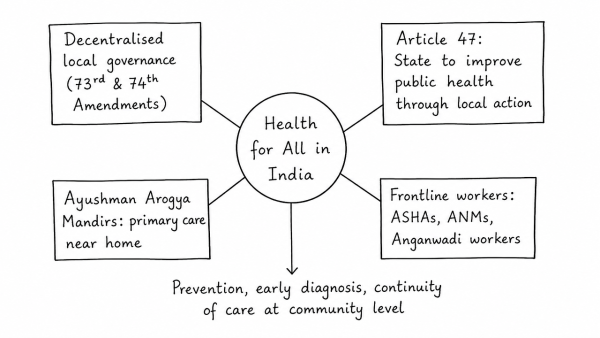
- Local institutional base: The 73rd and 74th Amendments support decentralised health and sanitation, while Article 47 directs the State to improve public health through local action.
- Primary care near home: Ayushman Arogya Mandirs, upgraded from SHCs and PHCs, provide screening, free medicines, diagnostics, maternal care and NCD management close to people.
- Frontline workers: ASHAs, ANMs and Anganwadi workers link households with the system, track pregnancy, immunisation, nutrition and chronic diseases, and reach remote and poor communities.
- Cost-effective prevention: Community interventions reduce out-of-pocket spending, prevent overcrowding at higher facilities and integrate health with water, sanitation and nutrition.
Thus, strong local healthcare institutions and workers are the foundation of universal health coverage and essential for making “Health for All” a reality in India.
Originally written on
August 31, 2026
and last modified on
August 31, 2026.