Analyze the salience of ‘sect’ in Indian society vis-a-vis caste, region and religion. (UPSC 2022)
In Indian society, sect is a belief-based, voluntary religious subgroup, unlike caste, region and religion, which are largely inherited identities. Its salience lies in the way it cuts across as well as reshapes these older social divisions.
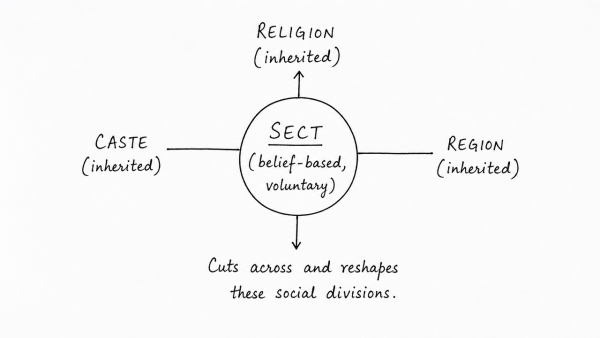
- Vis-a-vis caste: Sects often challenge caste hierarchy by stressing devotion, equality and moral discipline. Movements such as Lingayat and many deras have given marginalised groups a space for dignity, mobility and alternate identity.
- Yet caste persists within sects: Leadership, marriage and social status may still reflect caste lines. Thus, sects can oppose caste in ideology but reproduce it in practice.
- Vis-a-vis religion: Sects are internal divisions within a wider religion. They keep religions plural and dynamic, as seen among Shia-Sunni, Shaiva-Vaishnava or Digambara-Svetambara traditions. At the same time, sectarian authority may clash with individual rights, dignity and reform.
- Vis-a-vis region: Sects become rooted in local language, culture and memory. The Sattras in Assam, Varkari tradition in Maharashtra, and similar movements show how sects help build regional identity and social cohesion.
- Political relevance: In some regions, sects act as organised social networks and influence voting, patronage and public mobilisation, especially where state institutions are weak.
Thus, sect is socially significant because it is both a bridge and a boundary: it reformulates caste, diversifies religion and localises culture. Its role in India is therefore not marginal but central to understanding social change, identity and power.
Originally written on
September 3, 2026
and last modified on
September 3, 2026.