Analyze the role of satellite-based technologies in achieving climate-smart agriculture and food security in India. (UPSC 2026)
Satellite-based technologies are becoming central to climate-smart agriculture in India. They help farmers and governments monitor crops, water, weather and losses in near real time, improving both resilience and productivity. In a country where large areas remain rainfed and climate risks are rising, such tools are vital for food security.
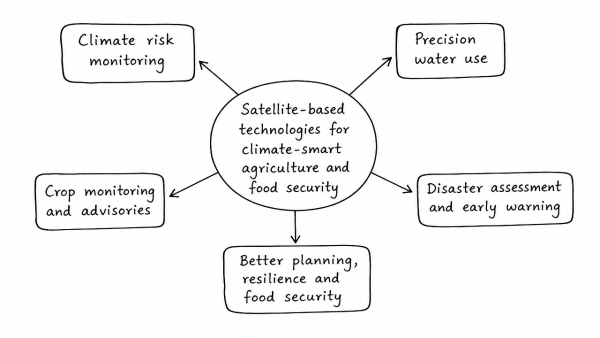
- Climate risk monitoring: Missions like NISAR, EOS-06 and INSAT-3DS support soil moisture mapping, cloud tracking and weather forecasting. This improves drought warning, flood assessment and seasonal planning.
- Precision water use: High-resolution satellite data helps estimate crop water requirement and identify stressed fields. This supports irrigation scheduling, reduces groundwater overuse and improves electricity efficiency.
- Crop planning and diversification: Satellite-derived land-suitability maps guide shifts from water-intensive crops to pulses, millets and other resilient crops, especially in rainfed regions.
- Decision support platforms: Krishi-DSS combines remote sensing, soil data, reservoirs and groundwater information to create a unified geospatial base for farm advisories and the “One Nation-One Soil Information System”.
- Food security management: FASAL provides pre-harvest estimates for major crops, helping with procurement, buffer stock planning and import-export decisions. Ground-truthing apps improve accuracy.
- Disaster response and insurance: Satellite mapping enables rapid loss assessment after floods or hailstorms and strengthens schemes such as YESTECH and CLAP for faster compensation.
These technologies reduce guesswork, improve input efficiency and support timely policy action. However, their full impact depends on better last-mile delivery, quality ground data, digital literacy and institutional coordination. With these in place, satellite-based systems can make Indian agriculture more climate-resilient, productive and food-secure.
Originally written on
September 5, 2026
and last modified on
September 5, 2026.