Analyze the distinguishing features of the notion of Equality in the Constitutions of the USA and India. (UPSC 2021)
The idea of equality in the USA and India shares a common liberal base, but their constitutional design and social aims differ sharply. The American model is mainly anti-discrimination in a formal sense, while the Indian model is also corrective and transformative, meant to redress deep social inequality.
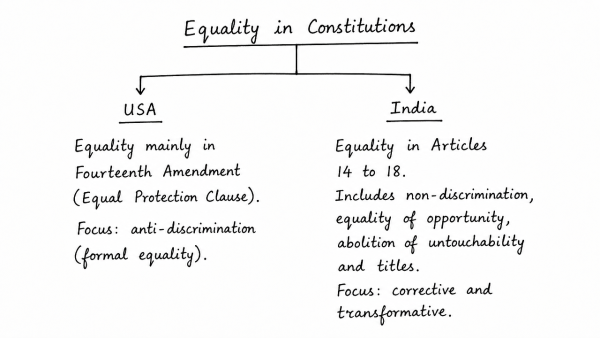
- Constitutional text and design
- USA: Equality is mainly found in the Equal Protection Clause of the Fourteenth Amendment.
- India: Equality is spread across Articles 14 to 18, covering equality before law, non-discrimination, equality of opportunity, abolition of untouchability and abolition of titles.
- Nature of equality
- USA: Emphasises formal equality and individual rights, with a tendency towards a colour-blind approach.
- India: Accepts substantive equality, allowing special measures for historically deprived groups such as SCs, STs, OBCs and EWS.
- Role of affirmative action
- USA: Race-based affirmative action has faced strong judicial limits; equality is protected against classifications, even remedial ones.
- India: Reservations are part of the equality code and are seen as tools to achieve real equality.
- Horizontal reach
- USA: Equality under the Constitution largely applies against state action.
- India: Certain provisions, such as Articles 15(2) and 17, also bind private actors.
- Judicial approach
- USA: Uses strict, intermediate and rational basis scrutiny.
- India: Uses reasonable classification, non-arbitrariness and manifest arbitrariness tests.
Thus, the US treats equality mainly as equal treatment under law, whereas India treats it as an instrument to dismantle social hierarchy and ensure equal status in a stratified society.
Originally written on
September 2, 2026
and last modified on
September 2, 2026.