Analyse why year-round connectivity in high-altitude border regions is critical for India’s national security. How does border infrastructure deter external threats?
Year-round connectivity in high-altitude border regions is not a development luxury; it is a core security requirement. In the Himalayas, seasonal isolation can delay reinforcement, weaken surveillance and expose remote posts to risk. For India, roads, tunnels and bridges are therefore instruments of deterrence as much as of mobility.
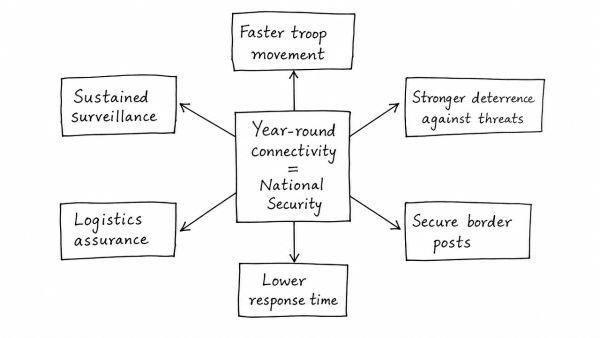
- Faster troop movement: All-weather links ensure rapid deployment of soldiers, weapons and supplies to Ladakh, Himachal Pradesh, Uttarakhand, Sikkim and Arunachal Pradesh.
- Lower response time: Tunnels such as the Atal Tunnel cut travel time sharply and keep routes open in winter, when passes are snowbound.
- Continuous logistics: Forward posts on the LAC and LoC need uninterrupted supply of fuel, food, ammunition and medical aid in extreme cold.
- Better surveillance: Reliable access improves patrolling, intelligence gathering and maintenance of border outposts by BRO, ITBP and the Army.
| Deterrence effect | Infrastructure signals that India can hold ground, reinforce quickly and sustain operations even in harsh terrain. |
| Strategic parity | It reduces the advantage of adversaries who have historically enjoyed superior border connectivity, especially along the LAC. |
| Dual use | Roads and tunnels serve civilians too, strengthening local presence and reducing vulnerability through development. |
- Force multiplication: Projects such as Sela Tunnel, Shinku La Tunnel and frontier highways create alternate axes for military movement.
- National integration: Improved access supports border economies and prevents depopulation of sensitive areas.
Thus, year-round connectivity strengthens both defence and resilience. By enabling quick mobilisation, sustaining remote deployments and making hostile adventurism costlier, border infrastructure becomes a powerful tool to secure India’s frontiers.
Originally written on
September 12, 2026
and last modified on
September 12, 2026.