Account for the failure of manufacturing sector in achieving the goal of labour-intensive exports. Suggest measures for more labour-intensive rather than capital-intensive exports. (UPSC 2017)
India’s manufacturing has not generated labour-intensive exports as expected; growth has tilted to capital-heavy sectors.
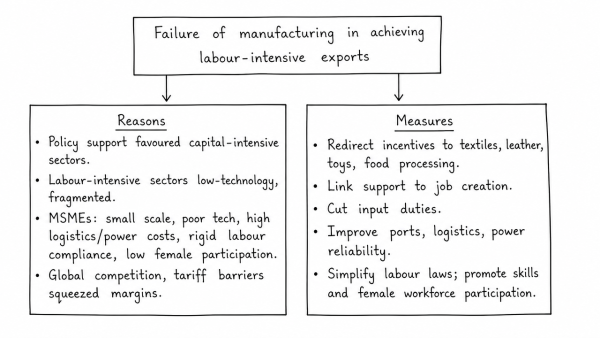
- Reasons: Policy support and demand favoured electronics, autos and other capital-intensive industries; labour-intensive sectors like textiles, leather and apparel remained low-technology and fragmented. MSMEs suffer from small scale, poor technology, high logistics and power costs, inverted input duties, rigid labour compliance, and weak female workforce participation. Intense global competition and tariff barriers further squeezed margins.
- Measures: Redirect incentives to textiles, leather, toys and food processing; link support to job creation; cut input duties; improve ports, logistics and power; ease MSME compliance; implement labour codes; strengthen skilling; promote clusters and women’s employment.
A labour-intensive export strategy needs lower costs, larger scale, simpler regulation and targeted support.
Originally written on
August 31, 2026
and last modified on
August 31, 2026.