Account for the change in the spatial pattern of the Iron and Steel industry in the world. (UPSC 2014)
The spatial pattern of the iron and steel industry has changed from being raw-material based to market- and port-based, and now towards energy-efficient, low-carbon locations. This shift reflects changes in technology, transport, trade and environmental needs.
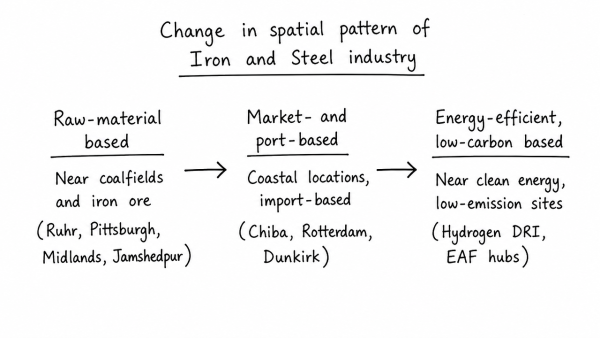
- Coal and ore proximity in the early phase: Heavy dependence on coking coal and iron ore kept plants near coalfields and mines, such as Ruhr, Pittsburgh, Midlands and Jamshedpur.
- Shift to coastal locations: Larger ships, cheaper bulk transport and lower fuel use made import-based steelmaking viable. Hence, mills moved to tidewater ports like Chiba, Pohang, Taranto and Visakhapatnam.
- Growth of mini-mills: Electric arc furnaces using scrap and electricity reduced dependence on coal and ore, favouring urban-industrial and market centres.
- New green steel locations: Decarbonisation is now attracting plants to regions with cheap renewable power, such as Sweden, Finland and parts of India.
Thus, the industry has moved from resource location to transport advantage, and now to energy and environmental efficiency, reshaping its world spatial pattern.
Originally written on
August 29, 2026
and last modified on
September 7, 2026.