A number of outside powers have entrenched themselves in Central Asia, which is a zone of interest to India. Discuss the implications, in this context, of India’s joining the Ashgabat Agreement, 2018. (UPSC 2018)
Central Asia is contested by China, Russia, Turkey and Gulf powers, yet it remains vital for India’s energy, trade, connectivity and security interests.
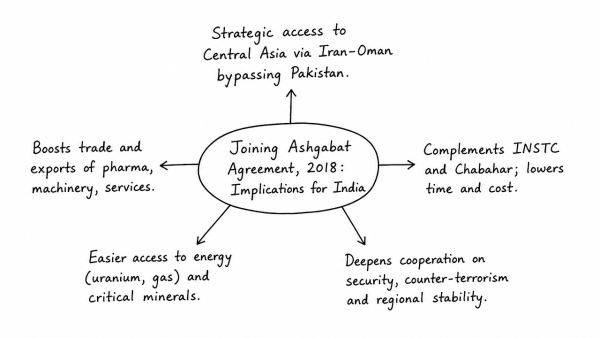
- Strategic access: Joining the Ashgabat Agreement gives India a legal transit corridor to Central Asia via Iran and Oman, bypassing Pakistan’s land barrier.
- Connectivity: It complements the INSTC and Chabahar, lowering time and cost for cargo movement.
- Economic gains: It can boost India-Central Asia trade and exports of pharmaceuticals, machinery and services.
- Energy and security: Easier access aids sourcing of uranium, gas and minerals, while deepening cooperation against terrorism, trafficking and Afghan instability.
Thus, the Agreement is a strategic connectivity tool that expands India’s reach in a competitive region, though benefits depend on infrastructure, implementation and sanctions constraints on Iran.
Originally written on
September 1, 2026
and last modified on
September 1, 2026.