Cyclone
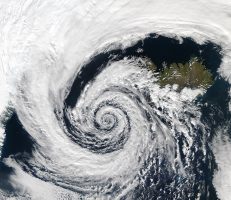
Cyclones are large-scale air masses that rotate around centres of low atmospheric pressure. They are defined by inward-spiralling winds that turn counterclockwise in the Northern Hemisphere and clockwise in the Southern Hemisphere due to the Coriolis effect. Cyclones exist on a wide range of spatial and temporal scales, from vast synoptic-scale systems such as tropical and extratropical cyclones to smaller mesoscale vortices including mesocyclones, tornadoes, and dust devils. They play a major role in global weather patterns, climate dynamics, and severe weather phenomena.
General Characteristics
A cyclone’s primary characteristic is its low-pressure core. Near the centre, the pressure gradient force acts outward from the low-pressure region, while the Coriolis force acts perpendicular to the wind direction, resulting in balanced, rotating airflow. In fully developed tropical cyclones, the centre becomes an eye—an area of calm conditions and the lowest atmospheric pressure.
Cyclones are strongly influenced by the hemisphere in which they occur. In the Northern Hemisphere, the rotation is anticlockwise, while in the Southern Hemisphere it is clockwise. The strongest winds occur on the eastern side of a northward-moving cyclone and the northern side of a westward-moving one in the Northern Hemisphere, with the pattern reversed in the south. Cyclones contrast with anticyclones, which are associated with high-pressure systems and opposite rotational patterns.
Cyclonic activity is not confined to Earth. Observations reveal prominent vortices on other planets, including massive storms on Jupiter, seasonal polar cyclones on Mars, and dynamic vortical systems on Neptune.
Formation and Cyclogenesis
Cyclogenesis refers to the processes involved in the formation or intensification of cyclonic systems. It encompasses a variety of mechanisms depending on the scale, environment, and type of cyclone.
Extratropical CyclogenesisExtratropical cyclones form outside the tropics, typically in mid-latitude regions where strong temperature contrasts create baroclinic zones. These systems often begin as waves along weather fronts. As the wave develops, warm and cold fronts form on opposing sides of the circulation centre. Cold fronts, which move faster than warm fronts, eventually catch up, resulting in an occluded front. This marks the mature stage of an extratropical cyclone, which then often transitions into a cold-core structure. Extratropical cyclones typically last two to six days, guided by upper-level flow such as the subtropical jet stream.
Tropical CyclogenesisTropical cyclones are warm-core systems that develop over warm ocean waters. Their formation requires six key conditions:
- sufficiently warm sea surface temperatures
- atmospheric instability
- high humidity in the lower and middle troposphere
- adequate Coriolis force to initiate rotation
- a pre-existing surface disturbance
- low vertical wind shear
Tropical cyclogenesis begins with organised convection and the release of latent heat, which lowers the surface pressure and intensifies the system. Globally, around 86 tropical storms form each year, with nearly half reaching hurricane or typhoon intensity, and roughly 20 becoming major storms.
Subtropical and Transitional CyclesCyclones may shift between extratropical, subtropical, and tropical phases. A tropical system moving into higher latitudes may undergo extratropical transition, while some extratropical cyclones can briefly acquire warm-core structures via warm seclusion. Subtropical cyclones display characteristics of both tropical and extratropical systems.
Mesocyclones and Other Small-Scale VorticesMesocyclones are warm-core, vertically rotating air columns embedded within severe thunderstorms. They may produce tornadoes when rotation tightens and extends downward. Waterspouts may also develop from mesocyclones or from intense convective environments with weak wind shear.
CyclolysisCyclolysis is the weakening or dissipation of a cyclone. It is influenced by factors such as loss of thermal contrast, increased wind shear, land interaction, or the infusion of dry air.
Historical Development of the Concept
The term “cyclone” was introduced by Henry Piddington, a 19th-century scientist based in Calcutta who published numerous studies of tropical storms. He described cyclones metaphorically as resembling a serpent coiling around its centre, a term that has since become standard in meteorology. His influential work, Laws of the Storms, contributed significantly to the early understanding of storm behaviour.
Structure and Dynamics
Cyclones share several structural elements regardless of type:
- Low-pressure centre: the defining feature, often forming the eye in mature tropical cyclones.
- Pressure gradient and Coriolis forces: maintain rotational balance.
- Wind field: strongest winds encircle the centre and vary by hemisphere and storm motion.
- Frontal systems: prominent in extratropical cyclones, with cold, warm, and occluded fronts marking sharp gradients in temperature and humidity.
- Vertical structure: tropical cyclones have deep warm-core circulations, whereas extratropical systems exhibit strong horizontal temperature gradients.
Upper-level cyclones may form without a corresponding surface low and can separate from large-scale trough systems during certain seasons.
Types of Cyclones
Meteorologists identify several primary categories, particularly on synoptic-scale weather charts:
Extratropical CyclonesThese form outside the tropics in regions of strong temperature contrast. They are responsible for much of the day-to-day weather in mid-latitudes and are often referred to as depressions or lows. Their structure includes well-defined warm, cold, and occluded fronts.
Tropical CyclonesWarm-core storms marked by intense convection, heavy rainfall, and strong winds. Names vary by basin:
- Hurricanes in the North Atlantic and northeastern Pacific
- Typhoons in the northwestern Pacific
- Cyclones in the Indian Ocean and South Pacific
Subtropical CyclonesHybrid systems displaying both tropical and extratropical features, often forming in regions with lower humidity and broader wind fields than typical tropical storms.
Polar VorticesLarge, persistent low-pressure systems located near the poles, particularly the Arctic. They influence cold air outbreaks and mid-latitude weather patterns.
Mesocyclones, Tornadoes, and Dust DevilsThese mesoscale vortices are smaller and shorter-lived. Tornadoes form from intense mesocyclones, whereas dust devils form in convectively unstable environments without involving frontal systems.
Life Cycle and Evolution
Cyclones undergo several key stages during their evolution. In extratropical systems, the sequence includes incipient wave development, intensification with mature frontal structures, occlusion as cold air wraps around the centre, and eventual dissipation. Tropical cyclones progress from tropical disturbances to depressions, storms, and potentially intense cyclones if environmental conditions continue to support growth.
Steering flows, particularly the subtropical jet stream in mid-latitudes or subtropical ridges in the tropics, control cyclone tracks. Landfall, cooler waters, or hostile atmospheric conditions typically weaken storms.
Importance and Meteorological Significance
Cyclones are essential to the redistribution of heat, moisture, and momentum in the atmosphere. They drive precipitation patterns, influence ocean circulation, and serve as critical components of the global climate system. Their associated hazards—strong winds, storm surges, heavy rainfall, flooding, tornadoes, and destructive waves—make them major subjects of meteorological research and forecasting.