Khijadiya Bird Sanctuary Emerges as Major Black-Necked Stork Breeding Site
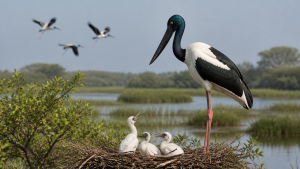
Khijadiya Bird Sanctuary in Jamnagar, Gujarat, has been identified as a major breeding site for the Black-necked Stork, scientifically known as Ephippiorhynchus asiaticus. The sanctuary is a Ramsar site and forms part of the wetland network of western India.
Khijadiya Bird Sanctuary
Khijadiya Bird Sanctuary is located in Jamnagar district of Gujarat and is known for its freshwater and brackish-water wetland habitats. The sanctuary has eight management zones and supports resident and migratory bird species.
Black-Necked Stork
The Black-necked Stork is a large wading bird in the family Ciconiidae. It is found in South Asia and parts of South-East Asia, and it uses wetlands, marshes, and shallow water bodies for feeding and nesting.
Study Findings and Nesting Ecology
Researchers from the Gujarat Ecological Education and Research Foundation conducted field surveys from July 2024 to March 2025 across 48 georeferenced sampling points. The sanctuary supported a peak seasonal population of 21 to 23 Black-necked Storks during the monitoring period, including breeding pairs, non-breeders, and juveniles.
During the breeding phase from October to December, four active nests were recorded and all achieved breeding success. Each pair produced two fledglings, giving a total of eight juveniles.
All monitored nests were built on Neltuma juliflora, an invasive tree species also known as gando baval in Gujarat. The nests were placed at heights of 3 to 4.5 metres, which is a recorded nesting pattern for the species in the sanctuary.
Wetland Features and Breeding Behaviour
The study recorded successful nesting sites in shallow, semi-perennial wetlands with water depths of 0.3 to 0.7 metres. These wetlands provided aquatic prey species that form part of the stork’s diet.
Behavioural monitoring recorded biparental coordination in nest care, with partner replacement during foraging departures in 94% of observed instances. The average nest attendance was 62 minutes per visit.
Important Facts for Exams
- Khijadiya Bird Sanctuary is a Ramsar site in Gujarat.
- The Black-necked Stork belongs to the family Ciconiidae.
- Neltuma juliflora is an invasive tree species known as gando baval.
- Wetlands with shallow water depths of 0.3 to 0.7 metres supported nesting in the study.
The study was published in the Journal of Threatened Taxa on 27 July 2026. The Gujarat Ecological Education and Research Foundation functions as an autonomous body under the Gujarat Forest Department.
| Related | |
|---|---|