Key Concepts in Planetary Magnetic Fields and Auroras
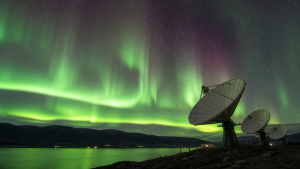
Planetary magnetic fields shape space weather, shield atmospheres, and help explain how planets evolve internally. They are also closely linked to auroras, the glowing displays produced when charged particles interact with magnetic fields and upper atmospheres. For prelims revision, the key ideas are the dynamo mechanism, magnetosphere, auroral formation, and how radio observations reveal magnetic activity in planets and exoplanets.
Planetary Magnetic Fields: Core Idea
A planetary magnetic field is produced within a planet and extends into surrounding space. The leading explanation is the dynamo theory, according to which magnetic fields arise from the movement of electrically conducting fluids inside the planet.
- Dynamo theory: Requires a liquid, electrically conductive layer, convection within that layer, and planetary rotation to organize the flow.
- Earth example: Earth’s field is generated by convection of molten iron and nickel in the liquid outer core, combined with the planet’s rotation.
- Field lines: These are imaginary lines used to show the direction and relative strength of a magnetic field. Outside the planet, they run from magnetic north to magnetic south.
- Importance: A magnetic field can protect a planet from charged particles and influence atmospheric loss, radiation environment, and space weather effects.
Earth’s Magnetic Field and Magnetosphere
Earth’s magnetic field is called the geomagnetic field. It stretches far into space and creates the magnetosphere, a protective bubble that interacts with the solar wind.
- Geomagnetic field: Generated by the geodynamo in Earth’s liquid outer core.
- Magnetic poles: The magnetic north and south poles are different from the geographic poles and do not remain fixed; they drift over time.
- Magnetic reversals: Earth has reversed polarity many times in geological history. The last full reversal, the Brunhes-Matuyama reversal, occurred about 780,000 years ago.
- Magnetosphere: The region dominated by Earth’s magnetic field. It deflects much of the solar wind and helps protect the atmosphere and surface from harmful radiation.
- Van Allen belts: Two toroidal belts of trapped energetic particles within the magnetosphere. The inner belt contains mainly high-energy protons, while the outer belt contains mainly high-energy electrons.
Exam point: Earth’s magnetic field is not static. Pole drift and polarity reversals are normal geological features of the geomagnetic record.
Auroras: How the Sky Glows
Auroras are luminous displays seen mainly near the polar regions. They are one of the clearest visible results of the interaction between solar particles and planetary magnetic fields.
- Formation: Charged particles from the solar wind, or from the magnetosphere, are guided along magnetic field lines toward the polar regions.
- Atmospheric collision: When these particles enter the upper atmosphere, they collide with atoms and molecules, exciting them.
- Light emission: As the excited particles return to their normal state, they release photons and produce visible light.
- Green auroras: Most common; usually caused by excited oxygen at about 100-300 km altitude.
- Red auroras: Produced by oxygen at higher altitudes, generally above 300 km.
- Blue and purple auroras: Often produced by excited nitrogen molecules.
- Types: Aurora Borealis in the Northern Hemisphere and Aurora Australis in the Southern Hemisphere.
- Solar trigger: Strong auroral activity is often associated with solar flares and coronal mass ejections, which intensify the flow of charged particles.
Magnetic Fields and Auroras Across the Solar System
Planets show very different magnetic field strengths and auroral behaviour. These differences make planetary magnetism an important topic in comparative planetology.
- Jupiter: Best known for the strongest planetary magnetic field in the Solar System. It produces powerful, persistent auroras and strong radio emissions, including decametric radiation.
- Saturn: Also has a significant magnetic field and auroras at its poles, associated with a metallic hydrogen dynamo.
- Uranus and Neptune: Their magnetic fields are strongly tilted relative to their rotation axes and are offset from their centres. Their dynamos are thought to arise from convective motion in a liquid layer of water, ammonia, and methane. Both planets show auroras.
- Mars: Does not have a global magnetic field today, though it had one in the past. It has localized crustal magnetic fields, but not strong global auroral activity.
- Venus: Lacks an intrinsic global magnetic field, so the solar wind interacts directly with its ionosphere.
- Mercury: Has a weak intrinsic magnetic field generated by a liquid outer core.
Radio Astronomy, Circular Polarisation and Exoplanets
Radio astronomy studies radio waves emitted by celestial sources. It is especially useful in identifying magnetic activity, including auroral radio bursts from exoplanets.
- Radio astronomy: Uses radio telescopes to detect electromagnetic radiation with wavelengths longer than visible light.
- Exoplanet: A planet orbiting a star other than the Sun.
- Detection methods: Many exoplanets are found through the transit method or radial velocity, but direct radio detection can reveal magnetic properties not accessible through those methods.
- Circular polarisation: A property of electromagnetic waves in which the electric field vector rotates in a circular pattern as the wave travels.
- Why it matters: Strong circular polarisation in radio bursts is often associated with magnetic radiation and auroral emissions.
- Research significance: Radio detection of planetary magnetism helps in the study of space weather, atmospheric protection, and the magnetic evolution of planets.
Key Prelims Takeaways
- Dynamo effect: Planetary magnetic fields arise from rotating, convective, electrically conductive fluids inside a planet.
- Earth’s core: The geomagnetic field comes from molten iron and nickel in the liquid outer core.
- Magnetosphere: Earth’s magnetic field forms a shield against the solar wind and helps protect the atmosphere.
- Van Allen belts: These trap energetic charged particles within the magnetosphere.
- Auroras: Produced when charged particles interact with a planet’s magnetic field and upper atmosphere.
- Colour clues: Oxygen generally produces green and red auroras, while nitrogen is associated with blue and purple.
- Jupiter: The Solar System’s strongest magnetic field is linked to powerful auroral radio emissions.
- Planetary contrast: Mars and Venus lack significant global magnetic fields today.
- Radio astronomy: Useful for studying magnetic fields, auroras, and exoplanetary properties.
- Circular polarisation: A key sign of magnetic radio emission in auroral bursts.
Recent Context
Astronomers have reported the first direct radio detection from an exoplanet, Beta Pictoris b, using the MeerKAT radio telescope array. The emission is linked to powerful auroras and provides the first direct measurement of an exoplanet’s magnetic field, estimated to be at least 1,250 times stronger than Earth’s.
| Related | |
|---|---|