Karnataka, Gnani AI Sign MoU to Train 1,000 Students
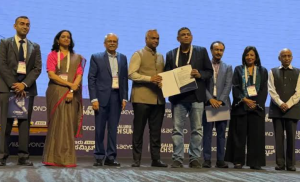
Gnani AI and the Karnataka government’s Department of Electronics, Information Technology and Biotechnology signed an MoU on 17 November 2026 at the Bangalore Tech Summit 2026. The programme aims to train 1,000 engineering and science students across Karnataka in voice AI and agentic AI engineering.
Training and AI models
Modules will cover multilingual speech recognition, text-to-speech, language models, conversational AI, prompt engineering, API integration, retrieval-augmented generation (RAG) and multi-agent systems. Students will complete graded labs and capstone projects to build and deploy multilingual voice agents and enterprise AI agents. Gnani AI will provide its models, platforms, development tools, computing resources, instructor-led sessions, teaching assistants and engineering mentorship. The programme forms part of Karnataka’s wider industry-skilling push, which targets 63,200 students and professionals.
Founded in 2016, Gnani AI was selected under the India AI Mission to develop sovereign foundational AI models after the Ministry of Electronics and Information Technology reviewed more than 500 proposals. Its Inya VoiceOS is a 5-billion-parameter voice-to-voice model that processes and generates speech directly; the company says it is India’s first such foundational model. Gnani is developing a larger speech-to-speech model, Warp, and has launched Evon, a 30-billion-parameter large language model. The company claims Evon outperforms larger models on MILU, an Indic-language understanding benchmark; this claim has not been independently verified.
Outside the mission, Gnani has released Prisma v3.0, a speech-to-text model for nine Indian languages and Indian English, and Timbre v3.0, a text-to-speech model with adjustable voice expressiveness.
Important Facts for Exams
- Speaker versus speech: Speech recognition concerns spoken content, whereas voice recognition identifies the speaker rather than what was said.
- TTS front end: A text-to-speech front end assigns phonetic transcriptions to words and marks text into prosodic units such as phrases and sentences.
- Sequence context: Recurrent neural-network language models retain information from earlier words while processing a sequence, unlike models that treat words independently.
| Related | |
|---|---|