India’s Death Rate Stays Above Pre-Covid Level
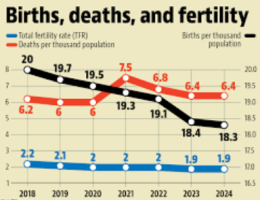
The 2024 Sample Registration System report of the Office of the Registrar General of India records a crude death rate of 6.4 deaths per thousand population and a total fertility rate of 1.9 children per woman. The report places the crude death rate above the 2019 and 2020 level of 6 and keeps the total fertility rate below the replacement level of 2.1 for the fifth consecutive year.
Sample Registration System
The Sample Registration System is a large-scale demographic survey system used in India to estimate birth rates, death rates, infant mortality, and fertility indicators. The Office of the Registrar General of India publishes the annual Sample Registration System report for population statistics.
Key Demographic Indicators
The crude birth rate in 2024 stood at 18.3 births per thousand population, compared with 18.4 in 2023. The infant mortality rate declined from 25 in 2023 to 24 in 2024. The urban death rate fell from 5.7 in 2023 to 5.6 in 2024, while the rural death rate remained at 6.8.
Mortality and Cause-of-Death Pattern
The share of deaths from respiratory infections was 5.7% for 2022-24, compared with 3.6% in 2017-19 and 4.9% in 2018-20. Cardiovascular diseases accounted for 32.1% of total deaths in 2024, up from 31% earlier. Deaths due to motor vehicle accidents rose from 2.9% to 3.2%, and suicides increased from 2.5% to 2.8%.
Important Facts for Exams
- The replacement level of fertility is 2.1 children per woman in demographic studies.
- The crude death rate measures deaths per thousand population in a year.
- The infant mortality rate measures deaths of children below one year of age per thousand live births.
- The sex ratio at birth in India for 2022-24 was 918 girls per thousand male children.
Sex Ratio at Birth
The sex ratio at birth for 2022-24 stood at 918 girls per thousand male children, compared with 917 in 2021-23. The Sample Registration System uses this indicator to measure the balance of births by sex in a given period.
| Related | |
|---|---|