Indian Railways to Quadruple Capacity on 11,000 km Routes
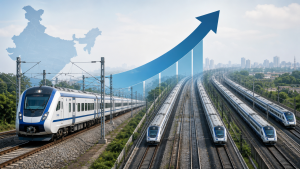
Indian Railways has announced a plan to convert seven high-density routes into four-lane, or quadruple-track, corridors across an 11,000-kilometre network. The identified routes carry about 41% of India’s railway traffic while accounting for 16% of the national route length.
Quadruple-Track Corridors
Quadruple tracking means adding two more railway lines to an existing double-line route, creating four parallel tracks. This arrangement allows separate movement of freight and passenger trains on the same corridor and is used on heavily congested rail sections.
The seven routes selected for capacity expansion are Delhi-Howrah, Howrah-Chennai, Chennai-Mumbai, Mumbai-Delhi, Delhi-Chennai, Mumbai-Howrah, and Delhi-Guwahati. These routes connect major industrial, port, and metropolitan centres across northern, eastern, western, and southern India.
Key Route Lengths and Project Scope
The Delhi-Howrah route is about 1,400 km long, and the Delhi-Mumbai route is about 1,500 km long. Construction is already under way on major sections of the 11,000-km network, and only a small portion is awaiting final detailed project report approval.
High-density rail corridors are sections of the railway network that carry large volumes of passengers and freight. Such corridors are prioritised for capacity augmentation, signalling upgrades, and track addition under Indian Railways’ infrastructure planning.
Important Facts for Exams
- Indian Railways is one of the world’s largest rail networks under a single administration.
- Quadruple tracking is different from doubling and tripling because it creates four operational tracks on one corridor.
- Freight trains in India usually run at lower speeds than passenger trains and often share the same broad-gauge network.
- Detailed Project Report, or DPR, is a standard planning document used before large infrastructure projects receive final approval.
Railway Network Classification
Indian Railways classifies routes by traffic density, line capacity, and strategic importance. High-density corridors are commonly linked with major cities, ports, and industrial belts, and they often require track expansion, electrification, and modern signalling systems.
The capacity upgrade on these routes is part of rail infrastructure development on the broad-gauge network, which forms the main backbone of passenger and freight movement in India.
| Related | |
|---|---|