India Targets 60,000 Tonnes Silk Production by 2030-31
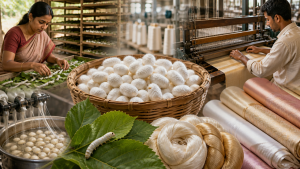
India has set a target of 60,000 metric tonnes of silk production by 2030-31, with an aim to become the world’s largest silk producer by 2028-29. The target was announced at the 77th Foundation Day of the Central Silk Board in Bengaluru on 21 September 2026, and the current annual production stands at 42,000 metric tonnes, up from 26,000 metric tonnes in 2014.
Silk Production in India
India is one of the major silk-producing countries and produces mulberry silk, tasar silk, eri silk, and muga silk. Sericulture is the cultivation of silkworms for silk, and it involves mulberry cultivation, silkworm rearing, cocoon production, reeling, and weaving.
Central Silk Board
The Central Silk Board is a statutory body under the Ministry of Textiles. It was established in 1948 under the Central Silk Board Act, 1948, and it works on research, development, and coordination in the silk sector.
Production Strategy and Technology Use
The production strategy includes strengthening the full value chain from sericulture to weaving. It also includes modern sericulture technologies, high-density production methods, and quality improvement measures. The Ministry of Textiles is using Artificial Intelligence, Geographic Information System, and Machine Learning for quality inspection and production enhancement in sericulture.
Important Facts for Exams
- India is the second-largest producer of silk in the world after China.
- Karnataka is the leading silk-producing state in India.
- Mulberry silk accounts for the largest share of India’s silk output.
- Sericulture is a labour-intensive agro-based industry and supports rural livelihoods.
Income and Rural Linkages
The government plans to raise farmers’ annual income to ₹10-12 lakh through higher mulberry leaf yields and more cocoon-rearing cycles. Silk production in India is linked to rural employment, farm-based income, and textile manufacturing.
| Related | |
|---|---|