India Administers 10 Million HPV Vaccine Doses in Under Nine Months
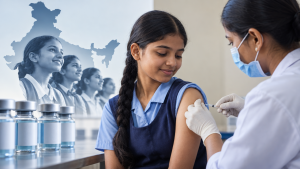
India’s National HPV Vaccination Campaign had administered more than 1 crore (10 million) Human papillomavirus (HPV) vaccine doses by 21 November 2026, less than nine months after Prime Minister Narendra Modi launched it in February 2026.
Coverage and eligibility
The free, voluntary campaign offers a single dose to 14-year-old girls, with parental consent, at designated government health facilities for cervical cancer prevention. Against an annual target cohort of about 1.2 crore girls, based on Registrar General of India 2021 population estimates, cumulative coverage was nearly 87% on 21 November. Gujarat, Uttar Pradesh, Andhra Pradesh, Mizoram, Madhya Pradesh and Bihar had reached 100% of their identified target populations. Uttar Pradesh led with over 29.33 lakh girls vaccinated, followed by Bihar (13.70 lakh) and Gujarat (7.75 lakh). The U-WIN digital platform supports real-time monitoring, beneficiary tracking, slot booking and digital certificates.
Court review and reported adverse events
In July 2026, the Delhi High Court rejected a request to suspend the programme. The central government reported 120 adverse-event cases among approximately 55.9 lakh doses administered at that time, with no reported deaths.
Important Facts for Exams
- Virus-like particle design: HPV vaccines use hollow virus-like particles assembled from recombinant coat proteins; they contain the L1 capsid protein, not L2.
- Screening after vaccination: HPV vaccination does not remove the need for cervical screening, because vaccines cover only some high-risk HPV types.
- Persistent-infection mechanism: Persistent infection with oncogenic HPV, rather than transient exposure, drives cervical carcinogenesis; HPV types 16 and 18 cause roughly 70% of cervical cancers worldwide.
- Indian quadrivalent vaccine: CERVAVAC, developed by Serum Institute of India with DBT and BIRAC support, is a quadrivalent vaccine targeting HPV types 6, 11, 16 and 18.
| Related | |
|---|---|