IIT Roorkee Team Develops Self-Powered Wound Dressing
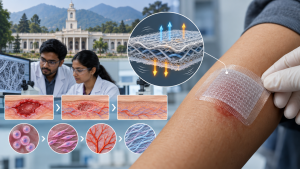
Researchers at IIT Roorkee and the Institute of Nano Science and Technology (INST), Mohali, jointly developed 3D-MIDAS, a flexible, self-powered electronic wound dressing. The research appeared in the August 2026 edition of Nano Energy.
How 3D-MIDAS works
Its name expands to 3D Monolithic Integrated Dipolar-Ionic Fibrous Architectural Scaffold. The dressing converts mechanical energy from body movement and stretching into electrical stimulation, without batteries, wires or an external power source. It is designed to restore natural electrical signals involved in tissue repair that can be disrupted by skin injury.
Study findings and publication
Laboratory tests showed approximately three times higher cell proliferation and 2.5 times greater cell migration than control conditions. Animal studies recorded approximately 90–95% wound closure within 13–15 days, with increased blood-vessel formation, improved tissue architecture and enhanced collagen deposition. The dressing retained stable electrical performance over 500 stretching cycles and showed stability for up to three months. The study was published in Nano Energy, Volume 157 (2026), Article 112266. Human clinical trials are required before routine medical use.
Important Facts for Exams
- Institutional status: The Institute of Nano Science and Technology, a collaborator on 3D-MIDAS, is an autonomous research institution under India’s Department of Science and Technology.
- Biomedical research areas: The Institute of Nano Science and Technology lists both nanomedicine and nanobiotechnology among its research areas.
- Wound-field generation: In intact epidermis, ion transport maintains a transepithelial voltage; barrier disruption creates lateral wound currents that can guide repair cells.
- Galvanotaxis: Directional cell movement under an applied electric field is termed galvanotaxis; keratinocytes, fibroblasts and endothelial cells can display this response.
| Related | |
|---|---|