IIT Roorkee Study Finds Western Disturbances Active Beyond Winter
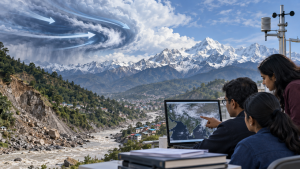
An IIT Roorkee study found that Western Disturbances are becoming more active beyond winter, extending into the pre-monsoon months of March to May. Published in the International Journal of Climatology in January 2026, the research analysed more than seven decades of atmospheric and rainfall data.
Changing patterns and Himalayan risks
The researchers recorded increased rainfall associated with these systems from March to May. They also found that Western Disturbances travel farther, carry more moisture and have stronger upper-level winds before reaching the Indian subcontinent. These changes raise the risk of flash floods, landslides and extreme rainfall in fragile Himalayan terrain. The study cited the 2025 Uttarakhand flood as an example of the disturbances’ growing influence.
Authors and recommendations
Professor Ankit Agarwal was the lead principal investigator; Dr Spandita Mitra, a PhD scholar, and Divya Sardana were also authors from IIT Roorkee. The study called for a review of climate models, forecasting frameworks and disaster-management strategies for Himalayan states, noting implications for water resources and disaster vulnerability in the Himalayas and adjoining regions.
Important Facts for Exams
- Formation trigger: Western Disturbances develop when high pressure over Ukraine draws polar air towards warmer, moisture-rich air, enabling cyclogenesis in the upper atmosphere.
- Moisture altitude: Western Disturbances carry moisture in the upper atmosphere, unlike tropical systems, whose moisture is carried in the lower atmosphere.
- Seasonal flow contrast: In the northern Himalayan region, the southwest monsoon generally advances east to west, while Western Disturbances travel west to east across north India.
- Monsoon interaction: Interaction between the monsoon trough and Western Disturbances can occasionally produce dense clouding and heavy precipitation.
| Related | |
|---|---|