IISc Team Demonstrates Electrical Switching Between Magnetic States
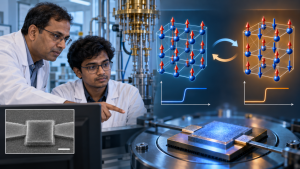
The Indian Institute of Science (IISc) in Bengaluru, Karnataka, announced on 30 July 2026 that its researchers had demonstrated electrical switching between two magnetic states in a complex oxide material. The findings were published in Nature Communications in 2026.
Current switches the material’s magnetic state
The research was led by Bhagwati Prasad, Assistant Professor in IISc’s Department of Materials Engineering, and PhD student Suryakanta Mondal. The team studied Sm₁₋ₓSrₓMnO₃, a material with multiple magnetic states. At low electric current it is ferromagnetic and has low resistance; above a critical current, it switches abruptly to an antiferromagnetic-like state with higher resistance. The transition is reversible, producing two distinct resistance states.
Potential applications in cryogenic electronics
Nanoscale tunnel devices made from the material, measuring about 250 × 250 nanometres, showed more than 200% magnetoresistance and two stable resistance states. The findings could inform compact, energy-efficient devices for information storage and logic operations, including cryogenic memory and logic technologies and future quantum-computing platforms that operate at very low temperatures.
Important Facts for Exams
- Parallel spin alignment: Ferromagnetic ordering aligns magnetic moments in the same direction, allowing their individual fields to combine into a larger macroscopic field.
- Antiparallel moments: In antiferromagnets, neighbouring moments can point in opposite directions, leaving the material’s bulk with no net magnetisation.
| Related | |
|---|---|