How did ancient Indian concepts of Dharma and Rajdharma limit sovereign authority? With suitable examples, explain how moral restraint preceded modern notions of constitutional supremacy.
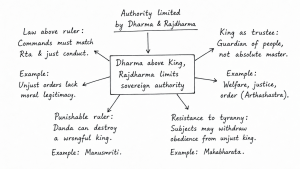
In ancient Indian political thought, the king was not the source of supreme authority. Dharma stood above the ruler, while Rajdharma defined the king’s duty to protect justice, order and public welfare.
How authority was limited
- Law above the ruler: Royal commands had to match Rta and just conduct; unjust orders lacked moral legitimacy.
- King as trustee: The ruler was a guardian of the people, not an absolute master.
- Punishable ruler: Manusmriti treats Danda as a force that can destroy a wrongful king.
- Resistance to tyranny: The Mahabharata allows subjects to depose a king who becomes predatory or fails to protect them.
Examples
- Mahabharata: stresses protection of subjects, justice and restraint in kingship.
- Kautilya: says the king’s happiness lies in the happiness of his subjects.
Thus, ancient India placed moral limits on power through Dharma and Rajdharma. This anticipated constitutional supremacy by making the ruler answerable to a higher norm of justice, long before modern written constitutions.
Originally written on
January 2, 2022
and last modified on
August 28, 2026.