Government Schools Improve Internet Access Across India
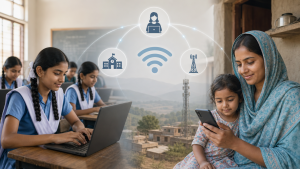
Government schools in India increased internet connectivity from 46.2% in 2023-24 to 63.1% in 2025-26, while the gap with aided and private schools narrowed from 28 percentage points to 16 percentage points. The UDISE+ report for 2025-26 also recorded internet facilities in 67.4% of all schools in India, compared with 53.9% in 2023-24.
Internet Access in Indian Schools
Government schools are institutions run by the Union Government, State Governments, or local bodies, and they form a major part of the school education system in India. UDISE+ is the Unified District Information System for Education Plus, a national database used for school-level statistics on infrastructure, enrolment, and facilities. Goa recorded 100% internet coverage in schools, while Andhra Pradesh recorded 99.2% coverage. Internet connectivity in schools is a key infrastructure indicator in UDISE+ because it is linked with access to digital learning resources, online assessments, and administrative systems.
Digital Divide and Women’s Internet Use
The digital divide refers to unequal access to digital devices, internet connectivity, and digital skills across social groups. UNESCO’s 2024 Gender Report, titled Technology on Her Terms, stated that 244 million fewer women than men use the internet globally. Internet access for women is connected with access to information, education, employment, and essential services. Digital inclusion programmes for women often combine connectivity, training, and practical use of technology for livelihoods and public services.
International Programmes on Digital Skills
UNESCO, Beijing Normal University, the Government of Ghana, and the Government of the United Republic of Tanzania launched a project by April 2026 to provide teacher training on gender-transformative pedagogy. The project aims to train about 60 ICT teacher educators in each country. The same project aims to support 500 girls in Tanzania and 240 girls in Ghana to build digital skills and confidence by February 2027. Gender-transformative pedagogy is a teaching approach that addresses gender norms in classrooms and learning materials.
Important Facts for Exams
- UDISE+ stands for Unified District Information System for Education Plus and is used for school education data in India.
- Goa recorded 100% internet coverage in schools in the 2025-26 UDISE+ data.
- UNESCO’s 2024 Gender Report is titled Technology on Her Terms.
- The global gap in internet use between women and men was estimated at 244 million users in UNESCO’s 2024 report.
Community and School-Based Digital Access Models
The NIIT Foundation used mobile learning models such as the Digital Bus in India by April 2026 to deliver digital education to women and girls in communities. The model linked digital skills with financial use cases. In Chile, the UN-backed Connected Communities initiative supported broadband connection points and digital skills training for rural women, including 83% from the Indigenous Mapuche community. In the United States, Chicago Public Schools extended the Chicago Connected programme in August 2025 to provide free high-speed internet access to thousands of families through the 2025-26 school year.
| Related | |
|---|---|