Page-4 of General Science – Physics
Gamma-Ray Bursts (GRBs)
Gamma-ray bursts (GRBs) are brief but extraordinarily powerful flashes of gamma radiation, representing the most energetic electromagnetic events known in the Universe. These bursts release, in a few...Neodymium-Iron-Boron (NdFeB) Magnets
Neodymium-Iron-Boron (NdFeB) magnets are among the most powerful permanent magnets known, widely used in modern technology due to their exceptional magnetic strength and compact size. They are composed...Prompt Fission Neutron Spectrum (PFNS)
The Prompt Fission Neutron Spectrum (PFNS) describes the energy distribution of neutrons that are emitted immediately during the nuclear fission process. It is a key parameter in nuclear...Barycenter
The barycenter is the common centre of mass around which two or more celestial bodies revolve due to their mutual gravitational attraction. It represents the exact balance point...Dark Matter Halo
A dark matter halo refers to the vast, invisible component of matter that surrounds galaxies and galaxy clusters, providing the gravitational framework within which visible matter such as...Einstein Ring
Einstein Ring An Einstein Ring is a circular optical phenomenon in astronomy that results from the gravitational lensing of light from a distant source, such as a quasar...Final Parsec Problem
The Final Parsec Problem is an astrophysical concept describing the theoretical difficulty that arises when two supermassive black holes (SMBHs) in the centre of a galaxy merger reach...India-based Neutrino Observatory (INO)
The India-based Neutrino Observatory (INO) is a proposed underground research facility dedicated to the study of neutrinos, one of the most fundamental and elusive particles in physics. Located...Neutrino Oscillation
Neutrino oscillation is a fundamental quantum phenomenon in which a neutrino created with a specific flavour (electron, muon, or tau) changes into another flavour as it propagates through...Quantum Tunnelling
Quantum tunnelling is a fundamental phenomenon in quantum mechanics in which a particle passes through a potential energy barrier that it classically should not be able to surmount....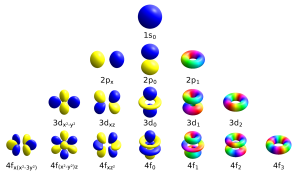
Atomic orbital
Atomic orbitals are mathematical functions used to describe the wavelike behaviour and spatial distribution of electrons in atoms. Within quantum mechanics, an orbital represents a region around the...