Fujiwhara Effect
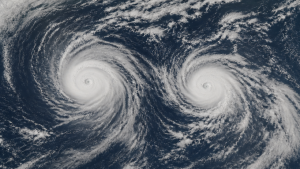
The Fujiwhara effect is a meteorological phenomenon in which two nearby cyclonic systems interact, begin to rotate around a common midpoint, and may either change course, weaken, or merge depending on their size, strength, and distance apart.
What is the Fujiwhara Effect?
The Fujiwhara effect occurs when two nearby cyclonic systems influence each other after coming within a critical distance. For tropical cyclones, this is generally less than 1,400 kilometers (870 miles). For extratropical cyclones, the interaction can occur at distances of up to 2,000 kilometers (1,200 miles). During this interaction, the storms rotate around a shared center called the barycenter. The direction of rotation depends on the hemisphere: counter-clockwise in the Northern Hemisphere and clockwise in the Southern Hemisphere.
Historical Background and Discovery
The phenomenon is named after Dr. Sakuhei Fujiwhara, a Japanese meteorologist who described it in a 1921 research paper. He used laboratory experiments with water vortices to explain how two swirling fluid bodies attract and rotate around each other. The concept later gained wider recognition in the United States after World War II, and modern satellite observations have made it easier to study in real time.
Core Dynamics of the Interaction
The behavior of interacting storms depends on several physical factors:
- Distance: The closer the storm centers, the stronger the interaction.
- Size and mass: A larger and stronger storm usually dominates and can pull the smaller system into its circulation.
- Symmetry: If both systems are of equal size and strength, they may orbit a point between them without a clear dominant partner.
- Environmental wind shear: External winds and ocean surface temperatures can determine whether the storms merge or separate.
The interaction can involve systems ranging from weak tropical depressions to very intense super typhoons.
The Five Classification Types
Meteorological models classify the Fujiwhara effect into five main types based on the outcome of the interaction.
1. Elastic Interaction (EI)
This is the most common form. The two storms change direction but retain their structure and later separate.
2. Partial Straining-Out (PSO)
The smaller storm loses part of its outer structure, especially its outer rainbands, but its core survives.
3. Complete Straining-Out (CSO)
The smaller storm is completely dismantled and dispersed by the larger system. This does not occur between storms of equal strength.
4. Partial Merger (PM)
The smaller storm merges into the larger one and loses its independent identity, though part of its core remains absorbed in the dominant circulation.
5. Complete Merger (CM)
Two cyclonic systems of similar size and strength combine into a single, larger cyclonic storm with a broader impact area.
Impact on Weather Forecasting
The Fujiwhara effect creates major difficulties for meteorologists because it can change storm tracks and intensities rapidly.
- Unpredictable trajectories: Standard models may fail to capture sudden shifts in direction, making landfall forecasts difficult.
- Rapid intensity changes: One storm may strengthen quickly after merging, or weaken due to wind shear caused by the other system.
- Extended rainfall: Interacting storms may slow down or stall, producing prolonged heavy rain and flooding.
Notable Historical and Recent Examples
| Year | Region | Interacting Systems | Observed Outcome |
| 1955 | Eastern US Coast | Hurricanes Connie and Diane | The two hurricanes rotated around a common center, altered their tracks, and caused severe inland flooding. |
| 1964 | Western Pacific Ocean | Typhoons Marie and Kathy | One of the first well-documented examples of binary interaction using early satellite technology. |
| 1995 | Atlantic Ocean | Hurricanes Iris and Humberto | Hurricane Iris interacted with Humberto, altering Iris’s track while Humberto was steered away. |
| 2005 | North Atlantic | Tropical Storm Alpha and Hurricane Wilma | The larger Hurricane Wilma completely absorbed the smaller Tropical Storm Alpha. |
| 2008 | Indian Ocean | Cyclones Fame and Gula | The two cyclones orbited a common center before dissipating. |
| 2017 | Eastern Pacific | Hurricanes Hilary and Irwin | The two hurricanes entered a close orbit and eventually merged into a single system over the ocean. |
| 2022 | Western Pacific | Typhoon Hinnamnor and Tropical Storm Gardo | Typhoon Hinnamnor dominated and absorbed Gardo into its circulation. |
| 2025 | Atlantic Ocean | Hurricanes Imelda and Humberto | The two systems displayed classic binary rotation, complicating forecasting models before weakening. |
Rare Facts for Prelims
- Origin of the term: The effect is named after a Japanese meteorologist, not a storm or place.
- Barycenter: The storms rotate around a shared center of mass, similar to binary motion in astronomy.
- Not all interactions end in merger: Many Fujiwhara interactions end with the storms separating after altering course.
- Hemisphere matters: The direction of rotation changes because of the Coriolis effect.
- Can affect extratropical systems: It is not limited to tropical cyclones alone.
- Forecasting challenge: Even advanced models can struggle when storms rapidly change intensity and track due to mutual interaction.