Dharampur Institute Auctions Venom from Four Gujarat Snake Species
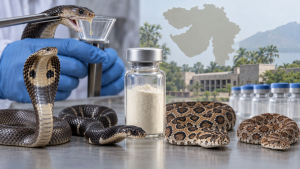
Dharampur’s Snake Research Institute in Valsad district, Gujarat, has auctioned lyophilised (powdered) venom from four venomous snake species found in the state to licensed antivenom manufacturers.
Auction prices and species
The venom came from the Indian cobra, common krait, Russell’s viper and saw-scaled viper. Indian cobra venom fetched ₹44,000 per gram, above its ₹40,000 base price. Saw-scaled viper venom fetched ₹56,500 per gram against a base price of ₹50,000. The venom’s quality reportedly contributed to prices exceeding expectations.
Institute and planned antivenom supply
Operating under the Gujarat Forestry Research Foundation, the institute follows World Health Organization guidelines for snake handling and venom extraction. It is identified as India’s second institution authorised to extract venom for antivenom production, after the Irula Snake Catchers Industrial Cooperative Society Ltd in Tamil Nadu. Gujarat plans to purchase antivenom produced from the locally sourced venom and distribute it to hospitals across the state for snakebite treatment.
Important Facts for Exams
- Host-animal immunisation: Antivenom is traditionally produced by injecting small venom doses into a domestic animal, then collecting and purifying the antibodies formed in its blood.
- Antivenom scope: Polyvalent antivenoms contain antibodies raised against venoms from several snake species, whereas monovalent products are directed against one species.
- Geographic venom variation: Snake venom composition can differ between populations of the same species, contributing to geographic variation in antivenom effectiveness.
| Related | |
|---|---|