CMFRI Reports Success in Vembanad Black-Clam Restoration Trial
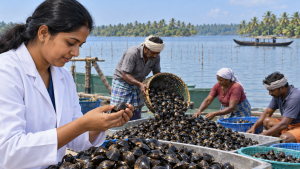
The Central Marine Fisheries Research Institute (CMFRI) reported a successful black-clam restoration trial at Vadakkumkara in Vembanad Lake, Alappuzha district, Kerala, on 2 October 2026. The trial recorded 80–90% survival after about a year of growth.
Trial results and harvest
CMFRI stocked five tonnes of black clam seed (Villorita cyprinoides) across one hectare in September 2025. Harvesting was under way, and scientists estimated a total yield of about 40 tonnes—seven to eight times the quantity stocked. A harvest festival marking the stock enhancement project was inaugurated by CMFRI Director Grinson George on 30 September or 1 October 2026.
Community support and catch trend
The project was implemented with a 100% subsidy for Scheduled Caste communities under the Central Government’s Scheduled Caste Sub Plan, in collaboration with the Thaikkattussery Black Clam Co-operative Society. CMFRI Senior Scientist R. Vidya coordinated the project. Black-clam catches in the Vembanad region fell from 75,592 tonnes in 2006 to 45,601 tonnes in 2024, a decline of nearly 40%.
Important Facts for Exams
- Salinity barrier: The Thanneermukkom barrier divides Vembanad into perennial brackish and freshwater sections, but restricts the upstream migration of fish and prawns.
- Ramsar designation: The Vembanad-Kol wetland system was recognised as a wetland of international importance under the Ramsar Convention in 2002.
- CMFRI institutional history: CMFRI was established in 1947 and brought under the Indian Council of Agricultural Research in 1967; its headquarters are in Kochi.
- Stock enhancement distinction: Fisheries stock enhancement adds juveniles to existing populations to support future harvests; unlike habitat restoration, it does not itself repair degraded habitat.
| Related | |
|---|---|