Bowring Hospital Wall Collapse: Inquiry Recommends Action
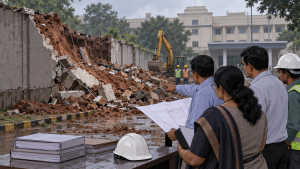
A compound wall at Bowring Hospital in Bengaluru, Karnataka, collapsed during heavy rain on April 29, 2026, killing seven people, including children. An inquiry report submitted to the state government around May 12–13 identified accumulated soil and construction debris, along with inadequate drainage, as key factors.
Inquiry report and recommendations
The report said unscientific filling of about 22,000 square feet within the hospital premises with soil and construction waste allegedly carried out by ASR Traders increased pressure on the wall. Technical experts assessed the pressure at 3,305 lb/ft, beyond the wall’s design capacity. The report recommended disciplinary action against four Health Department engineers: Assistant Engineer Somaraju, Assistant Executive Engineer Mahesh Kumar, Executive Engineer Thimmappa and Chief Engineer Uday Shankar. It also recommended a criminal case against ASR Traders, scientific reconstruction of the collapsed 200-metre section, technical standards for new construction and improved rainwater drainage.
Lokayukta inquiry
The Karnataka Lokayukta took suo motu cognisance on April 30 and ordered a detailed inquiry on May 1. A preliminary inspection found that the wall appeared to have been built weakly with cement hollow blocks; a large quantity of sand dumped nearby was also identified as a factor that further weakened it.
Important Facts for Exams
- State-specific powers: The Karnataka Lokayukta operates within a system where each state sets its own Lokayukta’s jurisdiction and powers through a separate law.
- Appointment process: A state Lokayukta is appointed by the Governor following nomination by the Chief Minister and consultation with specified state authorities.
| Related | |
|---|---|