Carbon Dating Dates Devadari Cave Evidence to About 10,000 Years
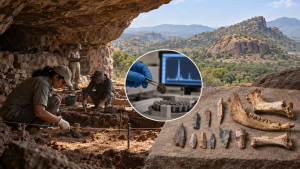
Carbon-dating results released in July 2026 placed archaeological evidence from Devadari Cave, in Sandur taluk of Ballari district, Karnataka, at about 10,000 years old.
Findings and dating
Finds at the cave include microlithic tools and animal bone remains, including those of cows and goats. The Physical Research Laboratory (PRL), Ahmedabad, conducted carbon dating on samples including microliths and human bone fragments in collaboration with the Archeology Science Center at IIT Gandhinagar. Researchers led by prehistory expert Ravi Korishettar said the discovery adds evidence of early human habitation in forested, hilly areas and broadens understanding of prehistoric settlement in South India. The evidence, found at about 850 metres above sea level, is considered the first trace of early human habitation identified at that elevation in South India. It is believed to span the Mesolithic and later Neolithic periods.
Important Facts for Exams
- Decay clock: Radiocarbon dating estimates when organic material stopped exchanging carbon, as its carbon-14 proportion then declines through radioactive decay.
- Radiocarbon half-life: Carbon-14 has a half-life of about 5,730 years, meaning half the isotope in a sample decays over that interval.
- Composite toolmaking: Microliths are small retouched stone pieces, often made from blades or flakes and hafted as components of composite cutting or hunting implements.
- Bone collagen: Radiocarbon dating of bone usually analyses preserved collagen; dietary carbon can cause reservoir offsets, particularly when aquatic foods contribute substantially.
| Related | |
|---|---|