BITS Students Develop Army Radio for Network-Independent Communication
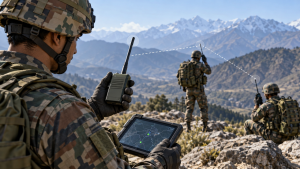
On 17 November 2026, BITS Pilani, Hyderabad students Samarth Alok Srivastava, 20, and Shresth Prakash Singh developed Krath Control, a pocket-sized radio for Indian Army communications, through their startup Krathveil.
Features and Army assessment
Weighing less than 180 grams, the device supports voice and data communication and live location sharing over an encrypted mesh network. It is designed to operate without mobile networks, communication towers or satellite links. Its network can reroute communication if a radio node drops out.
Krathveil targets a price of about Rs 40,000 per unit, compared with an estimated Rs 2 lakh for similar imported systems from the United States. Two Army units assessed the device for infrastructure-independent communication and situational awareness. They advised increasing its power output from 156 milliwatts to 1 watt and upgrading its antennas. The assessment was not a procurement order or induction into service.
Next steps
The Department for Promotion of Industry and Internal Trade has recognised Krathveil, which is seeking incubation at PIEDS. The startup plans to incorporate the Army’s suggestions and submit an upgraded version for another assessment within two to three months. The founders’ claim of a potential range exceeding 100 km between hilltops remains subject to field testing.
Important Facts for Exams
- Node relaying: A wireless mesh network forwards traffic through intermediate radio nodes, which make routing decisions using knowledge of the network topology.
- Half-duplex access: Two-way radios commonly use half-duplex channels: communication works in both directions, but only one user can transmit at a time.
- Encryption and authentication: Encryption converts readable data into ciphertext using a key; it protects confidentiality, while authentication is a separate function that verifies a sender or message.
- Positioning versus communication: A radio can transmit coordinates received from a separate positioning system; carrying location data does not by itself mean the radio provides positioning.
| Related | |
|---|---|